• Save
Simple Workbench Plans

Use this simple workbench plan to build a sturdy, tough workbench that'll last for decades. It has drawers and shelves for tool storage. It's inexpensive. And even a novice can build it in one day.

By the DIY experts of The Family Handyman Magazine

Overview: Design and materials

Does your current workbench consist of two sawhorses and an old door slab? Well, my friend, it's time to upgrade. There are hundreds of workbench plans out there, but not many of them call for plywood. Plywood makes a flat, stable work surface, and it doesn't need to be clamped, glued or planed. And it can easily be replaced if it gets too beaten up after years of abuse. If the idea of building drawers makes you break into a cold sweat, then build your workbench with two shelf sections and forget about the drawers. But if your mantra is, “The more storage the better,” then get yourself an additional half sheet each of 3/4-in. and 1/4-in. plywood, and build another two drawer sections to take the place of the lower shelf.

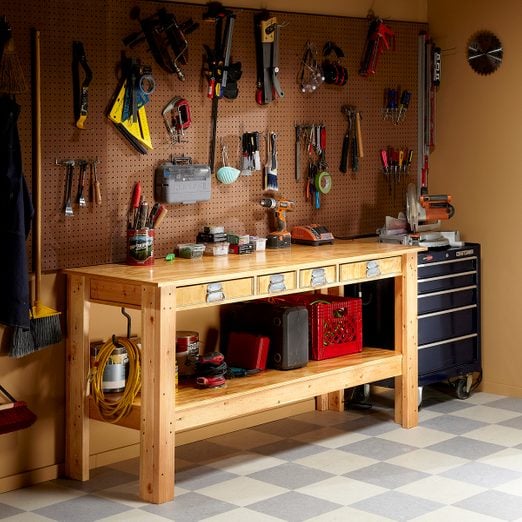
Completed workbench

Completed workbench

Simple, Sturdy Workbench

You get a workbench plan that's:

  • Simple enough to build on a Saturday
  • Easy enough for a beginner
  • Strong enough to hold a V-8
  • Tough enough to last a lifetime
Workbench components

Workbench components

Simple Workbench Components

4 legs, 2 boxes and a top: That's all there is to it. The legs are just 2x4s screwed together. The shelf and work surface could be constructed as simple boxes or made with drawer components. It's a perfect project for a beginner but a great bench for even the most advanced DIYer.

Step 1: Cut out the workbench parts

It's always nice to cut as many parts as possible before starting the assembly. That way, you can set aside the dust mask, safety glasses and hearing protection for longer periods of time, and the air isn't continually filled with sawdust. Cut everything except the lengths of the drawer components. In case things get a little out of whack during assembly, you'll be able to measure and fit the drawers to the actual openings.

Mark the cutting lines for your big sheets with a chalk line. Use a framing square to mark the lines for the smaller components, but don't forget that the blade will remove about 1/8 in. on every pass, so either add that space when you're marking, or mark and cut one at a time.

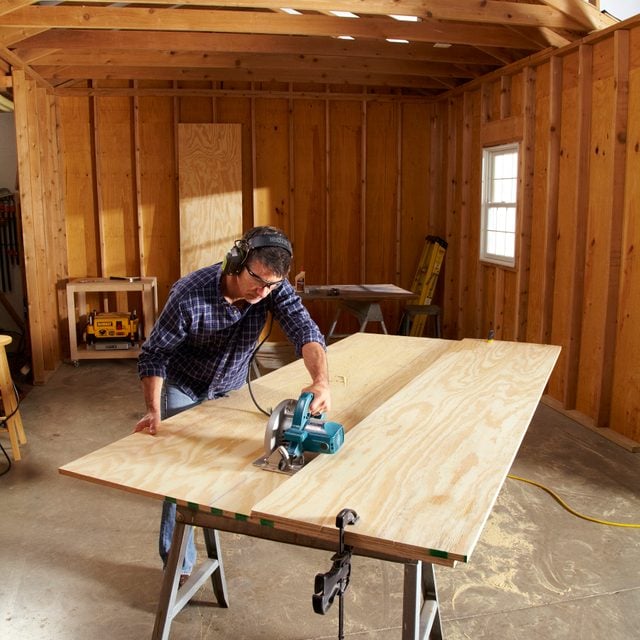
Start with the shelf top (C). Cut the whole length of the plywood. You'll have to freehand this one, but don't worry if your cut isn't perfect. The cut edge will be down low and backed up against the wall. Use the factory edge of the shelf top as a guide to cut the three other larger pieces (A, B, D; Photo 1). Think you might have trouble lugging around full sheets of plywood? Some home centers will cut them up for you if you ask.

After cutting the big parts to length, you'll have some medium-size chunks of plywood you can use as a guide to cut the smaller components, or you can clamp down your framing square as a guide. Next, cut the 2x4 legs (L). You can get two legs out of each 8-ft. 2x4 with about a 2-ft. piece left over. Set aside the remaining four 2-ft. pieces for use later. Cut the 2x4s that make up the shelf and drawer compartment frames (M—Q), starting with the long boards first.

Figure A: Simple Workbench

Figure A: Simple Workbench

Cutting Diagram

Cutting Diagram

Workbench Plans

For the names of the parts and their dimensions, see the Cutting List in “Additional Information” below. You can download and enlarge Fig. A Simple Workbench in “Additional Information” below.

The Cutting Diagram shows how to cut one sheet of 3/4-in. plywood. The second 3/4-in. sheet is much simpler: just cut lengthwise to yield parts C and D. Cut the drawer bottoms (J and K) from a 4 x 4-ft. sheet of 1/4-in. plywood.

You can download and enlarge the Cutting Diagram in “Additional Information” below.

Step 2: Assemble the shelf section and drawer section

Use the benchtop (D) as a temporary workbench (if you don’t have a door slab). Join the 2x4 frame with one 3-in. screw in the middle of each corner. This will reduce the chances that screws will collide when you attach the legs. Secure the plywood shelf to the frame using 1-5/8- in. screws about 12 in. apart. Use glue on every joint except the top sheet of plywood—you may want to replace it someday.

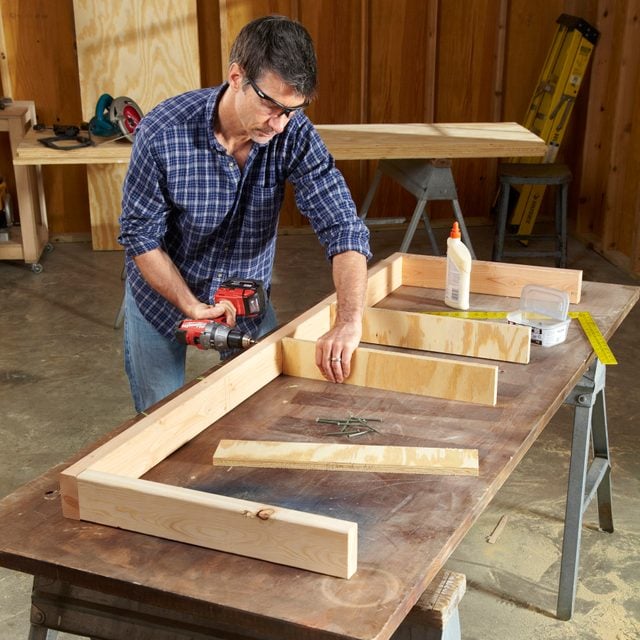
Assemble the three 2x4s that make up the drawer compartment frame (M, N) with one 3-in. screw at both corners. Mark lines for the location of the drawer dividers (E). Driving screws into the end grain of plywood can cause it to split. You can avoid this by predrilling holes with a 1/8-in. drill bit. Attach the plywood drawer dividers to the frame using two 3-in. screws in each one (Photo 2).

Lay the drawer compartment bottom (B) on top of the frame, and mark lines on the front of the plywood to line up the front of the drawer dividers. Then mark lines across the top of the plywood for the location of the screws. Clamp the box down with the drawer dividers aligned, then predrill holes for the dividers (Photo 3). You can often eliminate small warps and bows in the plywood by starting at one end and working your way down the line. Screw the plywood down with 1-5/8- in. screws. Space the screws about 12 in. apart the long way and 8 in. the short.

Before you repeat the process to attach the top of the drawer compartment, install screen mold on each end of the drawer compartment with 3d 1-1/4-in. brad nails. This will help the outside drawers slide in straight once the legs are installed.

Step 3: Attach the legs and shelf

Preassemble the legs with three 3-in. screws in each leg. Flip the drawer box upside down. Position the legs so the seams are facing the ends of the workbench. Secure the legs with two 3-in. screws on each side of each leg. Use a framing square as a guide (Photo 4). Next, cut the four 2x4s you have left over from the legs to 16 in., and use them as temporary spacers for the shelf. Secure the shelf to the legs with two 3-in. screws on each side (Photo 5).

Step 4: Install the top and trim molding

Before you screw down the benchtop, predrill holes for the screw eyes that will act as drawer stops. Drill two 3/32-in. holes for each drawer opening, 2 in. in from the sides and 1-1/2 in. from the front (see Figure A). Align the benchtop flush with the back legs and even on each side. Secure it with a row of 1-1/4-in. screws down the front, back and middle, spaced about every 16 in. Again, you'll have more luck getting a flatter surface by starting at one end and working your way down the line.

Attach the screen mold to the end grain of the plywood. Don't worry about the back side if your bench is going to sit against a wall. Nail on the screen mold pieces with 1-1/4-in. brads (Photo 6).

Step 5: Build the drawers

Double-check the sizes of your drawer openings, and cut each drawer bottom width 1/4 in. smaller than its opening. Cut the sides of the drawers (F) so they will be exposed at the front. This won't look as nice, but it will make the drawer front stronger and keep it from pulling off after you fill the drawer with heavy tools and hardware.

Glue and clamp the drawer sides together, but before you nail them, attach the bottom with 1-1/4-in. brads. Remove one clamp and set the drawer on edge with the other clamp hanging off the side of the workbench. Nail each corner together with three 1-1/4-in. brads. Remove the other clamp, and nail the remaining two corners together. Work fast so the glue doesn't set up before you get it all put together. Repeat the process for the other three drawers (Photo 7).

Step 6: Apply the finish

It's hard to stain plywood without its looking blotchy, so after sanding down the rough and sharp edges, we finished our workbench with Minwax PolyShade, a combination stain and polyurethane. It can be brushed on like regular polyurethane but adds a little color in the process. We did one coat on the whole bench and then added a couple more coats of regular polyurethane to the work surfaces. Apply an extra coat or two to the bottom of the legs so they won't wick up moisture from your garage floor.

Attach the drawer pulls. We chose chest handles instead of standard drawer pulls because of their low profile. They won't get in the way when you're clamping projects down to the front edge of the workbench.

Install the screw eyes/drawer stops after you insert the drawers. You may need a small screwdriver for leverage on the last few turns. All that's left is to show off your handiwork to your wife or neighbor, and get started using your new workbench on your next project.

Back to Top

Required Tools for this Project

Have the necessary tools for this DIY project lined up before you start—you’ll save time and frustration.

    • Circular saw
    • Drill/driver, cordless
    • Drill bit set
    • Tape measure
    • Chalk line
    • Framing square
    • Hammer
    • Wood glue
    • One-handed bar clamps

Required Materials for this Project

Avoid last-minute shopping trips by having all your materials ready ahead of time. Here's a list.

See the Materials List in “Additional Information.”

Comments from DIY Community Members

Share what's on your mind and see what other DIYers are thinking about.

1 - 16 of 16 comments
Show per page: 20   All

March 21, 11:12 AM [GMT -5]

just recently completed my workbench. I also cut three inches off the legs to add casters. Not sure what kind of finish I'll apply yet.

This was by far the biggest wood project I've attempted and found the directions pretty easy to follow. I made sure to study the directions before hand so that I would be able to create the bench without the plans.

Heres a Pic: http://oi50.tinypic.com/2cqo714.jpg

This project boosted my craftsmanship confidence and I hope to make a deck in my back yard this summer.

March 16, 1:05 PM [GMT -5]

it is a nice work bench. I agree that the estimated price is on the low side.I spent 150. just for the wood hear in vegas . I already had all the screws and hardware left over from other projects so i do not know exact cost . the editors tend to under estmate cost on the projects. this is the third project that i have done and all have cost way more than the estmated price

February 10, 10:54 PM [GMT -5]

I tried posting comments earlier but they didn't show up so I'm retrying. I have little to no experience in building stuff like this but I find myself with most of the tools to do it and it would come in very handy for future projects. To save money I wanted to use some leftover roofing supplies I had (lumber not hardware). Before I start cutting though I wanted to know if it would be alright to use OSB instead of ply. I hope someone out there can help me out on this. Thanks.

-Alex, Las Vegas

February 10, 10:11 PM [GMT -5]

I want to try to build this with some scrap materials from a roofing project I have. Can I use OSB in place of plywood or does it have to be ply? I'm hoping someone with more than my 0 experience can let me know before I waste my time.

January 21, 11:50 AM [GMT -5]

This is a great project. It's worth spending the extra time to build a second set of drawers instead of the shelf. I upgraded the 3/4" ply to maple plywood and spent the time to fill any cracks etc with Saman woodfiller. I also took the time to completely sand and "break" the edges of the plywood, trim, etc.
I used scraps of the 1/4" ply to cut L-shaped pieces to fit on the bottom of the legs. I then glued a piece of L-shaped stair tread to the plywood. Moisture from concrete floors won't be a problem.
By spending the time to sand and finish, you can have a workbench that looks a lot more expensive than what the materials cost.

January 14, 8:34 PM [GMT -5]

Looking forward to attempting this as my first big woodworking project. What type of wood did you guys (and girls) use for the project?

January 13, 6:20 PM [GMT -5]

I made this workbench this week with a small modification to the size of the table top. I cut the top at 72 x 30, then used the two pieces for my bottom shelf, 48 x 22 and 18 x 22. This gives me a little more room and matches the depth of my other workbench.

October 22, 12:48 PM [GMT -5]

Great project. I added a vertical support piece between the lower shelf the the drawer shelf to carry any load from the top of the bench down to a 2x4. I also used paint on all but the work surface.
But the article said to show it to my wife! I am a 58 byr old woman. Please don't assume all DIYers are men!!

October 15, 6:56 AM [GMT -5]

I just finished making a pair of these workbenches. It was a great project with very user-friendly instructions. As with most other comments, I agree that the estimated price is on the low side. It is more like 150-200 for a bench, based on the material price. It also takes longer than the one day that is listed, but was a very enjoyable project. Here are some helpful measurements for the drawer section for anyone who is planning to make this bench. For the Drawer section: Install the middle drawer divider (E) in the center of the bottom board (B), simply measure in 33in from each side and center the drawer divider on this line. For the 2 additional outside drawer dividers, measure in 21 and 3/4 inches from each end of (B) and center the shelf on this line.

Additional suggestions: I used Cabot stain in the Gunstock color with their semi-gloss poly and they turned out beautiful. (This is also the best deck stain out there). Materials - I bough one regular piece of cheaper sand-ply for the drawer section and the drawer sides and backs and bough a nicer piece of Oak plywood for the bench top, shelf, and drawer fronts. It finished nicely with good grain. I also used a veneer wood edging on the bench top, instead of the trim that I used for the rest of the bench. It is by the brand Band-it and I picked it up near the trim and molding at HD. It is applied using an iron or heat gun and gives a perfect wood grain finished look that matches the oak top. I also used colored deck screws in brown that were very close to my stain color.

Good luck and I hope this helps out.
Brian - GA

October 07, 1:40 AM [GMT -5]

Just completed. Very solid workbench. Took me more like 3 days to complete if you take your time. Had to make all the cuts since Home Center would not cut plywood for me. I bought this tool to help me make larger cuts: Kma2675 Circ Saw Guide Ripcut. It will work better than a table saw. I laid out the drawers before gluing and screwing them together since there were no measurements for the drawers. Make sure you have a circular saw guide (Kma2675 Circ Saw Guide Ripcut), a jigsaw, drill, sander and shop vac. Materials were pretty accurate. I used most of the 3" screws and the others sparingly. Just take your time and it will come out looking very nice. I also used
Minwax® PolyShades: color used: Honey Pine. Have fun!

September 22, 2:34 PM [GMT -5]

This is one of the nicest Workbenches I have see online so far. Even though I have never built anything with drawers, I think I will attempt this. I need a large work area (craft table) for my garage so when the wife and kiddo want to work on crafts they have a place to do it. I think I will build 2 with casters and roll them together when needed to create one large table so the family can sit around. Thanks for the plans!

September 16, 8:24 PM [GMT -5]

Yes, I agree with the other two comments. Cost was about $200 here in FL and there was no measurments for the drawer dividers. I built the drawers first and used them to help with the measurments. I am very happy with the end product though. It is a very sturdy workbench and looks great in the shop! I was hinking about adding casters as well.

September 16, 8:24 PM [GMT -5]

Yes, I agree with the other two comments. Cost was about $200 here in FL and there was no measurments for the drawer dividers. I built the drawers first and used them to help with the measurments. I am very happy with the end product though. It is a very sturdy workbench and looks great in the shop! I was hinking about adding casters as well.

September 03, 9:35 AM [GMT -5]

I added locking caster wheels on mine so I could move the bench around the garage as needed. Love the ease of moving the bench in a big shop or garage.

August 28, 9:58 AM [GMT -5]

I had the same problem. I (sort of) solved it by using the drawer pieces as spacers to determine where to attach the drawer dividers. I found the directions to be spotty at best throughout the entire project. The directions also never really mention that the largest piece of plywood is meant to be attached on top of one of the 22" pieces to form a smooth bench top - something shown only in the exploded view and something I didn't appreciate until I had already attached the largest piece directly as the top of the drawer compartment and found myself with an extra piece of 22" plywood left over. Finally, I don't know where the editors shop, but the actual cost of materials outside of Boston is WAY beyond their $20-100 estimate.

August 28, 12:59 AM [GMT -5]

I am struggling with step 2. Don't see anywhere in the directions or photos the measurements for where the drawer dividers should be placed.

+ Add Your Comment
closeX

Add Your Comment

Simple Workbench Plans

Did you complete this project?

  • Yes
  • No
Please add your comment
closeX

Log in to My Account

Log in to enjoy membership benefits from The Family Handyman.

  • Forgot your password?
Don’t have an account yet?

Sign up today for FREE and become part of The Family Handyman community of DIYers.

Member benefits:

  • Get a FREE Traditional Bookcase Project Plan
  • Sign up for FREE DIY newsletters
  • Save projects to your project binder
  • Ask and answer questions in our DIY Forums
  • Share comments on DIY Projects and more!
Join Us Today
closeX

Report Abuse

Subject
Reasons for reporting post
Save and organize projects in your Project Binder with a FREE Membership! Join today»

Free OnSite Newsletter

Get timely DIY projects for your home and yard, plus a dream project for your wish list!