

The 10 Best Air Purifiers for a Basement to Remove Dust, Allergens and Odors

Updated: May 12, 2024





You and your family can breathe easier with the best air purifier for a basement. Filter smoke, pet dander and odors with our editor-tested picks.
Our editors and experts handpick every product we feature. We may earn a commission from your purchases.Learn more.
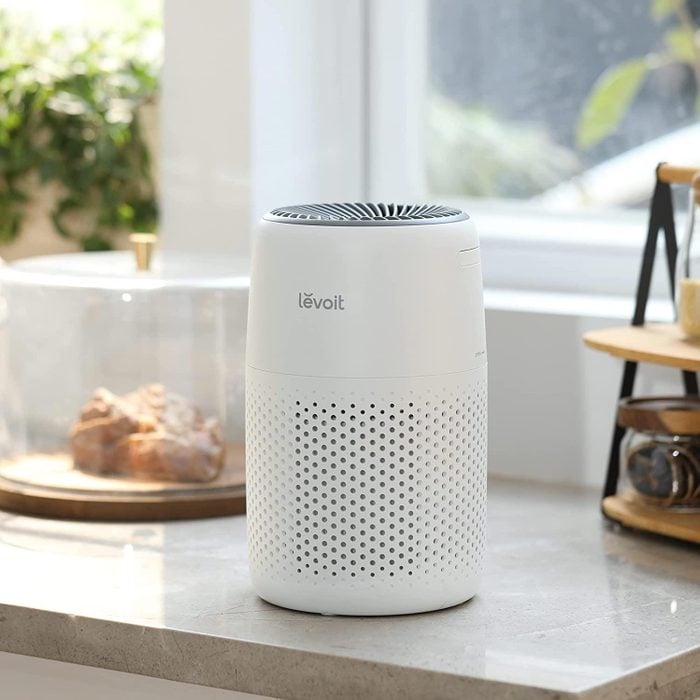
Good air quality has always been critical, even before the world was hit with the COVID-19. Unfortunately, basements are often neglected in favor of upstairs living areas and bedrooms. The good news is that adding a basement air purifier to your home’s subterranean space is easy to do and relatively affordable.
“Many basements have high levels of humidity, which can help microbes grow and lead to unwelcome musty odors. In this case, the high-efficiency particulate air (HEPA) filter will help reduce the microbial content and the activated carbon will reduce the odor, but having both reduces growth, as well as better comfort, a dehumidifier component is preferred,” says Jason “The Germ Guy” Tetro, a microbiologist.
Often dank and humid, basements (even finished basements!) are known to harbor dust, mold and other airborne pollutants. Air-purifying machines effectively eliminate the threat of microscopic particles, impurities and allergens that can lead to severe health problems—especially for those suffering from asthma or allergies. The best air purifiers for a basement are also excellent for removing unpleasant, musty odors due to excess humidity, a leaky sewage line or a faulty sump pump.
With families spending a lot of time “below ground” these days doing laundry, tinkering on DIY projects or playing ping pong, air purifiers are more important than ever. But you can breath a (clean) sigh of relief: We found the best air purifiers for basements to suit everyone’s needs.
 via merchant
Best Overall Basement Air Purifier
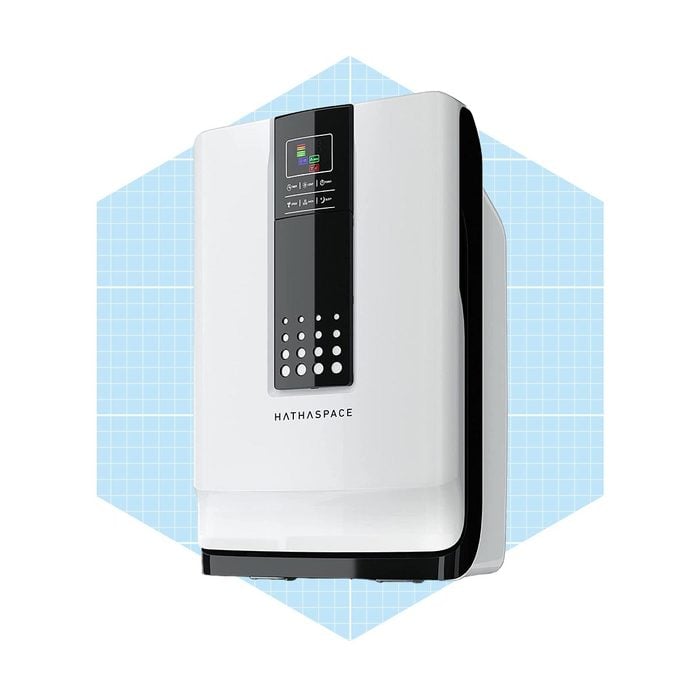
Hathaspace Smart Air Purifier
This five-in-one basement air purifier filtration system removes particles as small as 0.3 microns (µm) while also eliminating 99% of smoke, making it one of the best air purifiers for basements, garages and other odorous rooms. Equipped with a four-stage HEPA filter, the Hathaspace does a number on dust and allergens, pet hair and dander, smoke, volatile organic compounds (VOCs), viruses, bacteria and musty odors—effectively cleaning up to 700 square feet of air per hour. We also love how the freestanding unit’s slim profile means you can lean it up against a wall or on a counter so it’s out from underfoot.
Pros
- Sensor detects pollutants and adjusts fan speed accordingly
- Built-in, energy-saving sleep mode
- Air quality feedback display
- Remote control
- Has nearly 14,000 five-star ratings on Amazon
Cons
- Produces small amounts of ozone when ionizer feature is on
 via merchant
Best Budget Basement Air Purifier
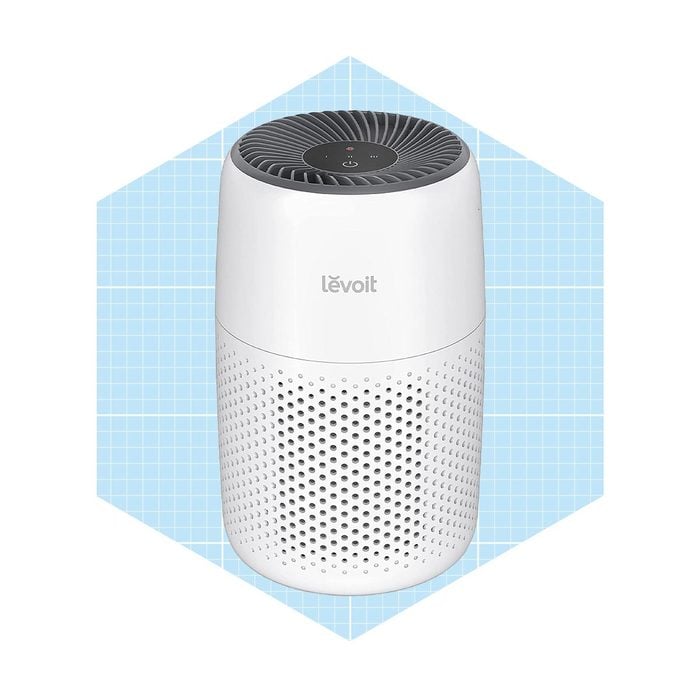
Levoit Core Mini Air Purifier
Founded in 2017, this woman-owned company wins our pick for best basement air purifier on a budget. The Levoit Core Mini is an exceptional value, and it’s also incredibly minimalist and uncomplicated in the best possible way. It fits on a shelf or tucks inconspicuously into a corner, making it the top option for dusty basements less than 200 square feet. For larger spaces, try the editor-reviewed Levoit 400s air purifier.
The Levoit purifier features a 360-degree air intake that guarantees clean air circulation. But what makes this product really special: Essential oils can be added to the diffuser pad to eliminate basement odors and keep your stuffy space smelling sweet and fresh.
Pros
- Affordable
- Can be used with essential oils
- Weighs less than four pounds
- Noise level as low as 25 decibels (dB)
- Comes in white, cream and dark black
Cons
- Power cord is short
- Not ideal for large rooms
 Allison Robicelli for Family Handyman
Best Basement Air Purifier for Mold
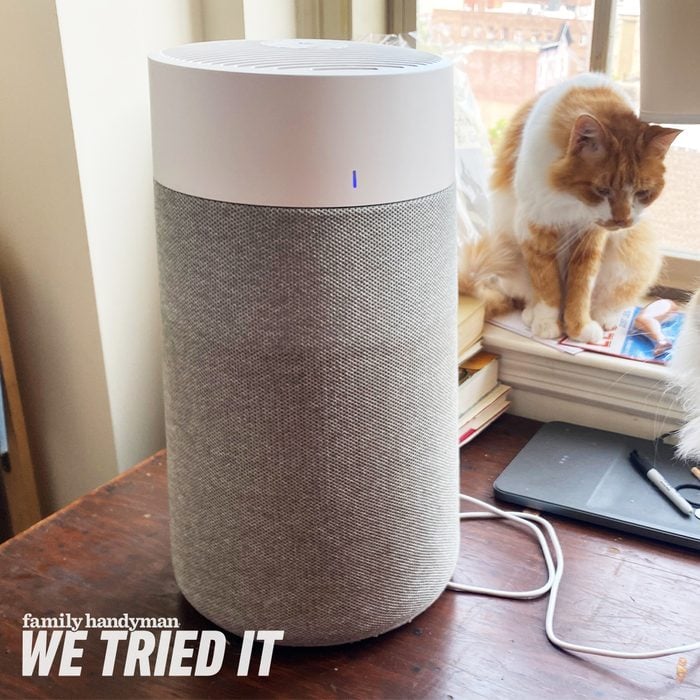
Blueair Pure 411i Max
Looking for an air purifier that kills germs and mold? Consider the Blue Pure 411i Max. This editor-tested air purifier uses HEPASilent technology to remove pollutants, allergens and contaminants from the air while keeping noise to a minimum. Blueair air purifiers don’t detect mold, but they do remove it from the air—though mold remediation is still necessary to completely eradicate it.
A triple-board-certified allergy, asthma, and immunology specialist at the Asthma and Allergy Wellness Center reviews all Blueair purifiers. We also appreciate the integrated air sensors, app-controlled timers and the ability to connect to Wi-Fi for remote control.
“While this air purifier doesn’t boast a ton of bloated smart features, it does offer a few fun perks for app users,” our tester writes. “The optional “welcome home” setting automatically switches the air purifier on when you get close to home, so fresh clean air is waiting upon your arrival. The app also uses advanced machine learning to offer filter life tracking and voice control via smart home devices like Alexa.”
Pros
- Removes at least 99.97 % of airborne particles as small as 0.1 µm
- HEPASilent dual filtration technology clears the air quickly
- Simple two-button design
- Controlled via a smartphone app
- Made of recycled materials
- 60-day home trial
Cons
- Other cloth color options must be purchased separately
 Elizabeth Heath For Family Handyman
Best Basement Air Purifier for Dust
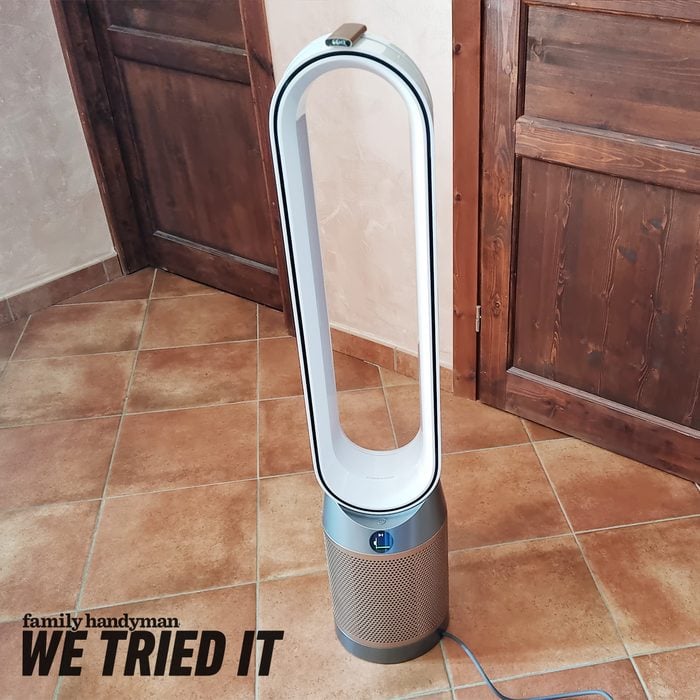
Dyson Purifier Cool Formaldehyde
Apart from offering a cool breeze during the hotter months, the Dyson Purifier Cool Formaldehyde also works as a True HEPA air purifier. The display screen shows levels of VOCs in the air, signals when the filter needs to be replaced and has a room temperature indicator. Once turned on—either through the app, the remote, on the unit or with voice control—this editor-tested air purifier captures 99.97% of particles 0.3 µm in size.
“The air-purifying features are harder to verify, because you either have to trust the digital display or buy a separate air quality monitor—I opted for the former. But, the cooling features are excellent, as this tower fan really does serve as a great way to cool a single room.”
Pros
- Automatically senses, captures, and traps pollutants
- Has 10 air speeds
- Fan offers fixed position or rotates
- Sealed HEPA H13 filter detects formaldehyde and other VOCs
- Controlled via app, remote, the unit or voice control
Cons
- Noticeable hum at higher settings
- Pricey
 TMB STUDIO
Best HEPA Basement Air Purifier
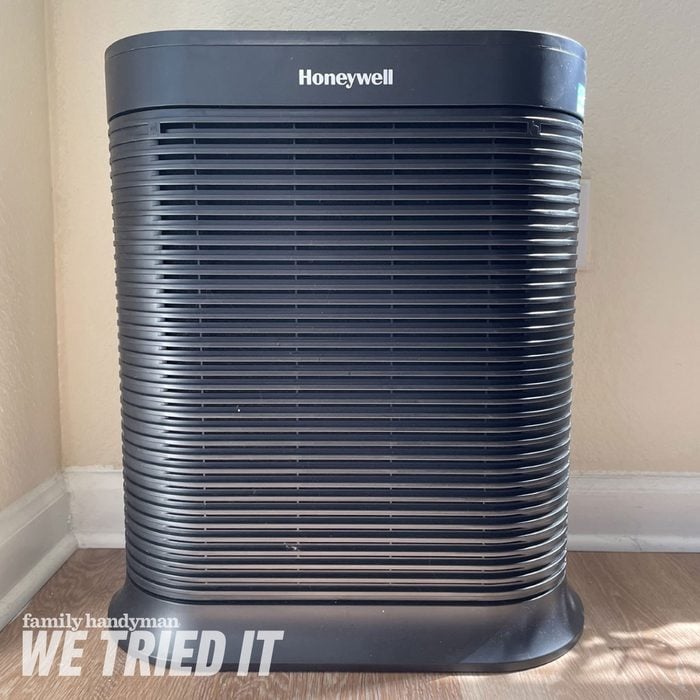
Honeywell True HEPA Air Purifier
HEPA filters remove microscopic particles, such as dust, pollen, pet dander and smoke from the air. The Honeywell True HEPA air purifier works in large rooms up to 465 square feet. There are four filters inside the filter housing—three certified HEPA filters and one odor-reducing pre-filter.
“My favorite features are the timer and the dimmer,” writes our tester in her Honeywell review. “These thoughtful extras take it from good to great. The timer saves energy while the dimmer saves sleep. I was also pleasantly surprised by how quiet it is. Even on its highest setting, it’s no louder than my tower fan or furnace.”
Pros
- Uses three True HEPA filters
- Cleans up to 1,500 square feet in an hour
- Filters wildfire smoke, pet dander, dust and pollen
- Three air-cleaning levels, including Turbo Clean for musty areas
- Sits against a wall or standalone
- Filers only need to be changed once per year
Cons
- Not for bathrooms or damp locations
 via merchant
Best Basement Air Purifier for Large Rooms
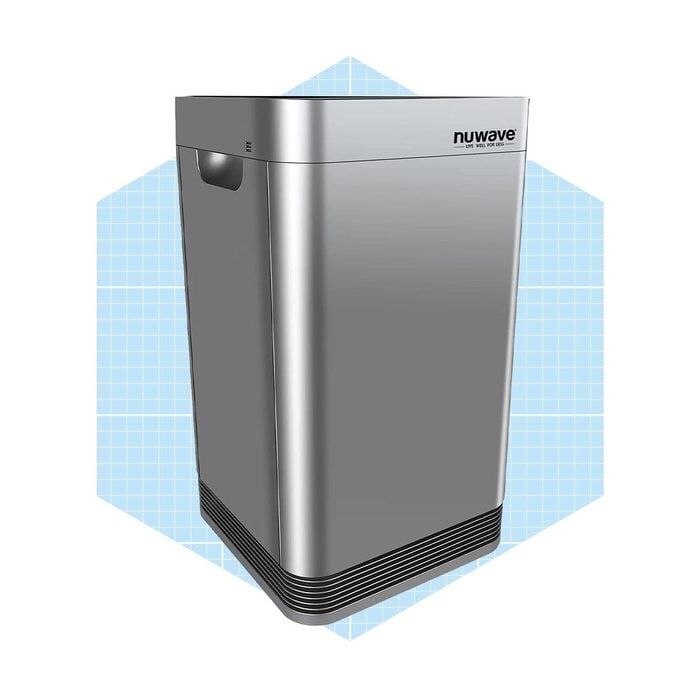
Nuwave OxyPure Pro Air Purifier
Say hello to an air-purifying device with big power—up to a whopping 2,671 square feet per hour of purifying power, to be exact! That’s why the Nuwave OxyPure is the best pick for large basements. It’s also incredibly mobile, with four wheels to roll around the basement, or you can grab it by the ergonomic handle to easily carry it up and down the stairs. Never-rust stainless steel filters are washable and reusable for up to 20 years, so no more spending more money on changing out filters.
Pros
- Purifies up to 2,671 square feet within one hour
- Captures 100% of 0.09-µm particles
- Six timer settings with auto shutoff
- Wi-Fi capabilities
- Washable, reusable air filters
Cons
- Expensive
 via merchant
Most Quiet Basement Air Purifier
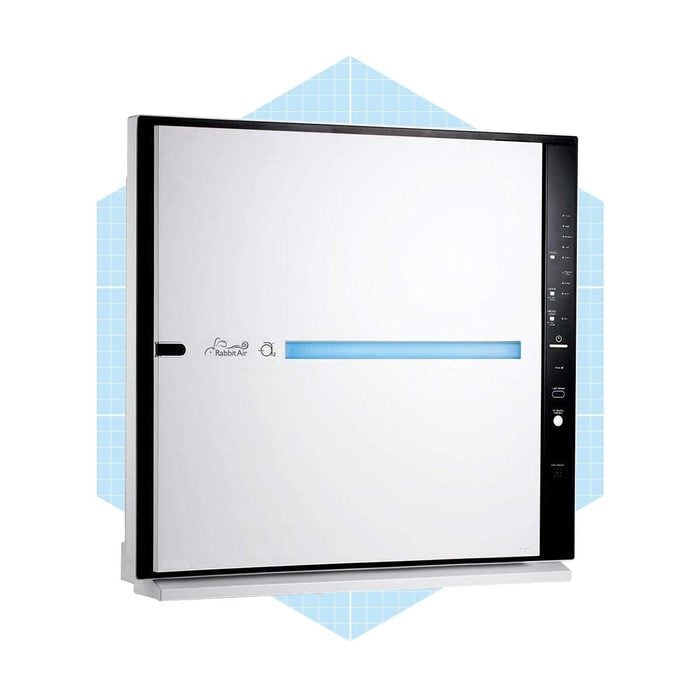
Rabbit Air Minus Air Purifier
The Rabbit air purifier is sleek, smart and stylish, as well as nearly silent. That last part is thanks to the five-speed state-of-the-art brushless motor, with a noise range starting at a hushed 20.8 dB. It has six stages of replaceable filters that absorb all types of toxins. The 19.4-pound unit sits on a desk, stands alone on the floor or mounts to a wall.
The flexible placement options make it particularly helpful if you’re low on space or remodeling a basement. There’s even a purple mood light that allows you to control the ambient light, and a customizable front panel to add images by the likes of Monet, Van Gogh or Hello Kitty.
Pros
- Motor sound barely detectable at the highest speed
- Zero ozone emissions
- Wi-Fi enabled
- Various mounting options
- Flat design
- Five-year warranty
Cons
- Expensive
- The air quality indicator light doesn’t shut off
 via merchant
Best Basement Air Purifier for Allergies
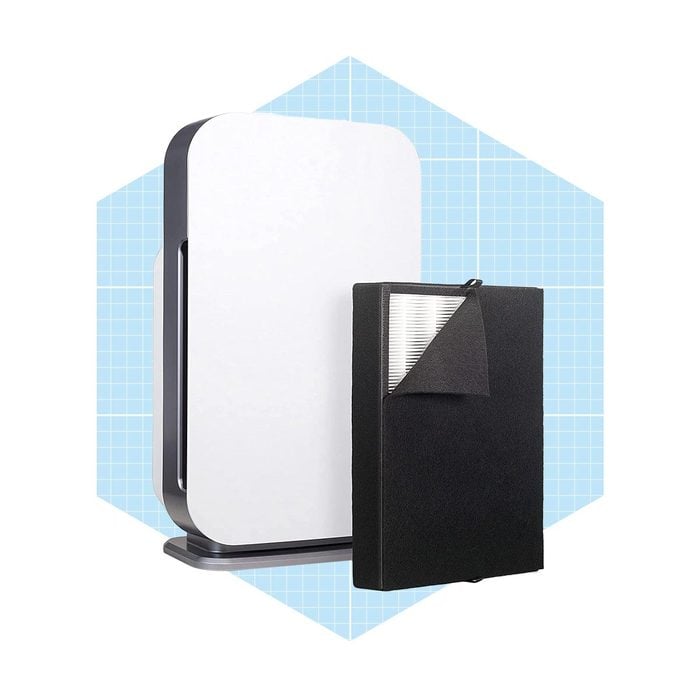
Alen FlexAir Purifier
Pollen and allergens are no match for the Alen FlexAir purifier. Developed by airflow engineers at National Aeronautics and Space Administration (NASA), the BreatheSmart filter captures 99.99% of airborne particles that trigger allergies. It’s a smart pick for any earthly space, from small to extra-large basements, as well as bathrooms, bedrooms, living rooms, offices, nurseries and kitchens.
Verified purchaser, Paige Tyler, says she purchased the FlexAir because she was experiencing allergy symptoms, but only at night and in her own home. “After two days of full-time usage, I was able to breathe at night without the use of Afrin nose spray. When the sun peeped through our windows, the air was no longer filled with dust particles,” she writes. She calls it a “complete game changer,” and adds, “I would highly recommend it to anyone suffering sinus congestion on a regular basis.”
Pros
- Filter specifically captures allergy and asthma triggers
- SleepScore validated claims
- Has the size and look of a modem
- Energy Star-certified
- Comes in six finishes
- Covers up to 700 square feet
Cons
- Some reviews say the high-fan setting is loud
- Replacement filters are pricey
 VIA MERCHANT
Best Basement Air Purifier with Dehumidifier
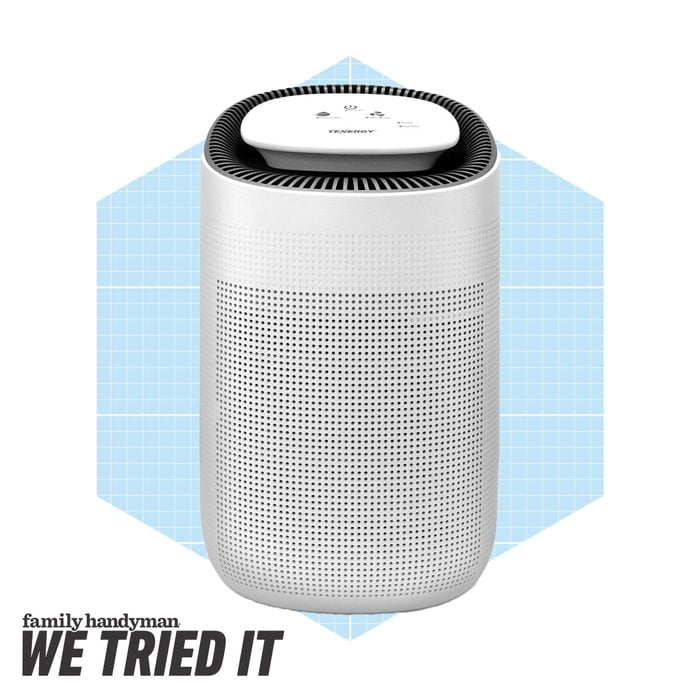
Tenergy Sorbi Air Dehumidifier and Purifier
Our associate shopping editor, Emily Way, owns her own Tenergy Sorbi, which she keeps in her small apartment bathroom. The bathroom doesn’t have a fan, so a built-in dehumidifier is a must. Between an automatic shutoff when the reservoir fills up to its relatively quiet operation to its adjustable airspeed, we’d say that it’s well worth the inexpensive price tag.
Removing any excess moisture is the key to preventing mold in basements and bathrooms, and the Tenergy Sorbi does a bang-up job. Folks can run the air purifier and dehumidifier separately, and HEPA filtration ensures that the air that comes out of the unit is clean (and dry) as a whistle.
Pros
- Combines both a dehumidifier and air purifier
- Inexpensive
- Only weighs seven pounds
- LED indicator, auto shutoff, and water level sensor
- True HEPA filtration
- 22 cubic feet per minute airflow speed
Cons
- The filter needs change at least every three months
- Not ideal for large rooms
 VIA MERCHANT
Best Ionic Basement Air Purifier
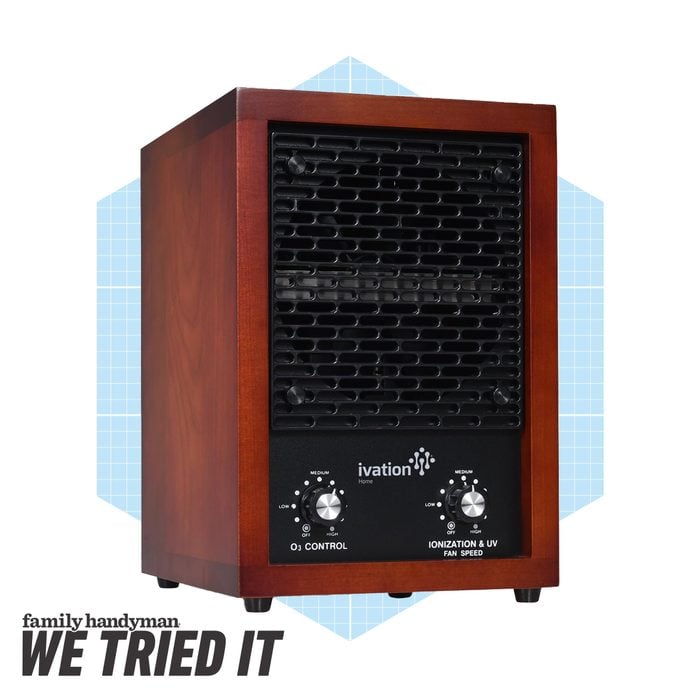
Ivation HEPA Air Purifier and Ionizer
The sleek and simple Ivation HEPA air purifier and ionizer works like a traditional HEPA air purifier, but with the added bonus of a built-in air ionizer. Unlike air purifiers and sanitizers that use fans and filters to trap harmful contaminants within the device, an ionizer “zaps” impurities as they float around the room, attacking the molecules and neutralizing them.
A HEPA filter ensnares large particles, such as dust and pet hair, and the unit’s larger ray filter targets the contaminants you can’t see. This filter, resembling an old automotive air cleaner, also includes a carbon filter to absorb VOCs and foul house odors, a photocatalytic filter and ultraviolet (UV) germicidal lamp with virus-killing properties.
Pros
- Electrical charge converts oxygen to ozone with built-in ionizer
- Five-stage purification process
- Built-in ionizer clears rooms of dust, dander and other airborne impurities
- Covers up to 3,700 square feet
- Reasonably priced
Cons
- Use with care—ozone can have harmful effects on health
What to Look for When Buying a Basement Air Purifier
Wondering how to find the best air purifier for a basement? The first thing to consider is the size and dimensions of your space. Next, do a “sniff test” to help determine if you might have mold. If so, snag a basement air purifier with a good HEPA filtration system. Another option for the best air purifier for mold in a basement are units with ultraviolet (UV)-C light features, which kill germs and mold spores.
Why You Should Trust Us
I’m a culture and lifestyle writer, reviews expert and DIYer who covers everything from pests to pool cabanas to painting. For over a decade, I was the owner of a successful faux finishing, mural and children’s furniture business before moving to a career in writing. Since I’m around so many smelly products, I know a thing or two when it comes to yearning for fresh air.
The Family Handyman team also consulted Jason “The Germ Guy” Tetro, a microbiologist and host of the Super Awesome Science Show, which explores how science fits into our everyday lives. He’s been involved in health-related microbiology and immunology for the last 35 years. He has also written two books, The Germ Code, which was shortlisted as Science Book of the Year in 2014, and The Germ Files, which spent several weeks on the national bestseller list. Tetro has also co-edited The Human Microbiome Handbook, which provides an academic perspective on the impact of microbes in human health.
How We Chose the Best Basement Air Purifiers
Choosing an air purifier isn’t just a matter of eliminating odors. For those suffering from allergies, an air purifier is an essential appliance that brings serious relief. Basement air purifiers should offer additional functionalities that target basement-related air issues, such as mold, moisture and humidity.
We aren’t distracted by bells and whistles when it comes to seeking out the best basement air purifiers. Our shopping experts combed through reviews, stacked features against each other and considered a variety of budgets in our search for the best air purifier. We care about one thing first and foremost: Does the air purifier do what it says it does?
After narrowing down our list to the top 10, we consulted a germ expert to ensure that our picks stood up to his rigid criteria. The result? We’re confident that these are hands-down the best air purifiers for basements on the market.
FAQ
How do air purifiers work?
According to Tetro, air purifiers are electronic devices that sanitize air to remove impurities and pollutants. They work by using a fan to suck air in and send it through one or more filters. The filters capture and neutralize the particles as they pass, pushing the clean air back out into the living space. Some units have ionizers to help improve air quality, but these should be used with care, as they produce ozone that can affect health.
What’s the difference between an air purifier and a dehumidifier?
Air purifiers do just that: purify the air. Dehumidifiers, on the other hand, draw humidity out of the air. Drying up a moist basement suppresses the growth of unhealthy mold and discourages bugs, such as silverfish, cockroaches and spiders, from moving in.
“A dehumidifier is simply a machine that extracts water from the air. It does not trap odors or microbes. That’s why a combination of the two is best for basements,” says Tetro.
Do air purifiers work for removing smell and mold in basements?
Does your basement have disagreeable household odors? To stamp out bad smells, a basement air purifier with a carbon filter is a must. “The HEPA filter will remove the airborne mold, but will not affect surfaces,” says Tetro. “As for the smell, if there is an activated carbon component, then smells will also be reduced.” To completely remove mold in a basement, you’ll need a mold remediation plan.
Source:
- Jason “The Germ Guy” Tetro, a microbiologist, host of the Super Awesome Science Show and author of The Germ Code and The Germ Files
Originally Published: February 01, 2023

