

How to Install Luxury Vinyl Plank Flooring
Updated: Dec. 04, 2020
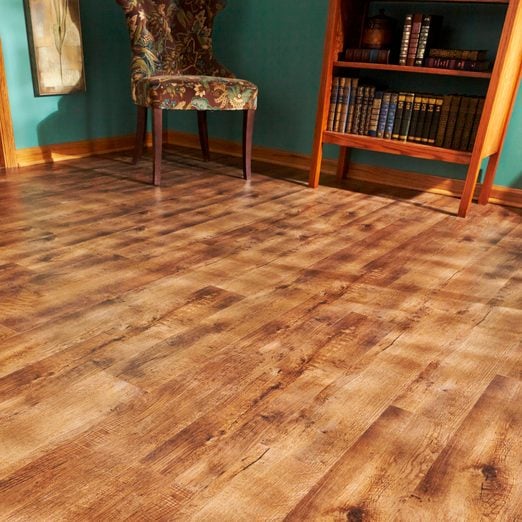
Get a great-looking new floor in one day






 Time
Time A full day
 Complexity
Intermediate
 Cost
Cost$101–250
Introduction
Luxury vinyl (LV) is tough and good-looking—and the easiest flooring material you’ll ever install. These tips and tricks will help you get the job done right.
Tools Required
- Air compressor
- Air hose
- Aviation snips
- Belt sander
- Brad nail gun
- Chalk line
- Cold chisel
- Dust mask
- Hammer
- Hearing protection
- Knee pads
- Putty knife
- Safety glasses
- Sanding block
- Square
- Straightedge
- Tape measure
- Utility knife
Luxury vinyl flooring (LVP) is similar to sheet vinyl, but it’s thicker, more durable and easier to install. It comes in tiles and planks, but this article covers planks only, and uses a product called Adura LockSolid. It’s a floating floor which means it isn’t fastened to the subfloor—it just lies there.
Luxury vinyl is the fastest-growing category in the flooring industry. LVP starts at about a couple of dollars per square foot, similar in price to medium-grade laminate. It’s available at flooring stores and home centers.
Project step-by-step (9)
Sand Down the High Spots
- Find the high and low spots on wood subfloors with a straightedge.
- Note: The floor height should not rise or drop more than 1/8 inch over the span of 4 feet.
- Sand down the high spots with a belt sander equipped with a coarse-grit belt.
- Note: This is a dusty job, so turn off your furnace to avoid spreading dust all over the house, and wear a dust mask.
- Pro tip: Use the coarsest sanding belt you can find, such as 40- or 60-grit.

Fill in the Low Spots
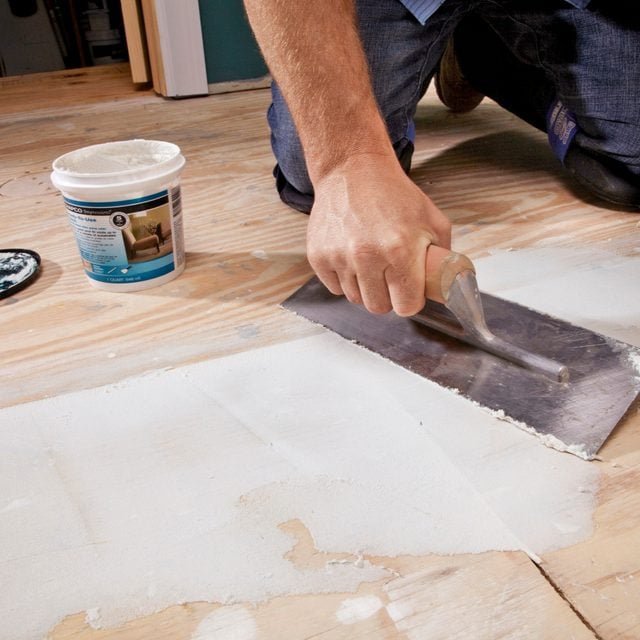
- Fill the low spots with floor patch, and feather it out with a trowel.
- Pro tip: Avoid self-leveling floor patch. The floor doesn’t have to be level; it just has to be smooth.
Begin and End with Half a Plank or More
If you lay the planks parallel to the longest wall as you’re installing vinyl plank flooring, you’ll end up making fewer cuts. But don’t start that first row with full planks without figuring out how wide your last row is going to be. Neither the first nor the last row should be ripped down much smaller than half a plank.
Measure the width of the room, and divide it by the width of the exposed portion of the plank before you start installing vinyl plank flooring. For example, if your room measures 123 in., and your flooring is 5.75 in. wide, you’d divide 123 by 5.75, which is 21.39. That is, it would take 21.39 planks to complete the floor. Because this .39 represents less than half the width of a plank, you would want to cut down the first plank by an inch or so to increase the size of the last plank.


Undercut Doorjambs
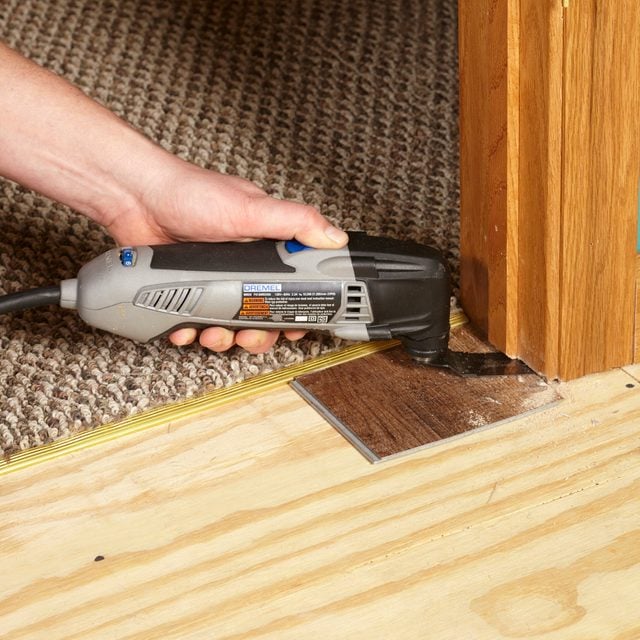
- Trim jambs and casing so you can slide the flooring underneath.
- Pro tip: An oscillating multi-tool works great. Use a small scrap of flooring as a guide.
Leave an Expansion Gap Along the Walls
- Insert shims to create about a 1/4-inch to 3/8-inch gap between the flooring and the walls.
- Note: These gaps allow the flooring to expand freely with temperature changes.

Snap the Planks Together
- Snap the planks in the first row together end to end.
- Slide the tongue of the first plank on the second row into the groove of the first row at a low angle and lay it on the floor.
- Install the second and subsequent planks in each row by locking the ends together, and then you work your way down the plank, pushing the tongue into the groove as you go.
- Pro tip: It helps to twist and bend each plank into place.

Watch Your Floor Height
New flooring raises or lowers the final height of the floor, which can create unexpected problems. Here are some things to keep in mind:
Jambs
If you’re pulling out old flooring that is thicker than your new stuff, you’ll end up with gaps under the doorjambs. To prevent that, you could cover the subfloor with a layer of 1/4-inch underlayment to raise the height of the entire floor.
Dishwasher
In most cases, there’s enough space above the dishwasher so that you can raise the floor level a little and still reinstall the dishwasher. But check the gap between the top of the dishwasher and the countertop first just to be sure.
Stairs
Be careful when changing flooring that butts up to a flight of stairs. Building codes allow no more than a 3/8-inch difference between the heights of the lowest and tallest stair risers. Changing the floor height at the top or bottom of stairs will alter riser heights and could create a trip hazard.
Existing sheet vinyl and carpet
If your kitchen floor is sheet vinyl and the dining room is carpet, don’t forget that the sheet vinyl will have a 1/4-inch underlayment beneath it, but the carpet won’t. If you want to install LV flooring in both, you’ll have to remove the underlayment in the kitchen or add some to the dining room.

Stagger the Seams
- Stagger the seams at least 6 inches, and don’t start or end any row with a plank less than 6 inches wide.
- Pro tip: Open several boxes at once and mix them up to ensure a varied pattern.
Tap in the End Planks
- Hook the pull bar onto the end of the piece, and tap stubborn seams closed.

Install Bridge Molding
- Cover the expansion gap between the flooring and the base trim.
- Pro tip: Don’t nail into the flooring—that will prevent the floor from expanding freely.

Around the Doorjambs: Planks Parallel to Openings
Land the seam in the door opening
It’s easier to work away from door openings than into them, but sometimes that’s not an option. When working parallel to a door, make sure the seam on the row that intersects the jamb lands inside the door opening. Mark and cut the first plank, then tap it into place using a scrap of flooring and a tapping block.
Bend the second plank into place
Mark and cut the second plank to fit, and then slide it under the jamb. Bend it up in the middle so you can lock it into place. This is another situation where the flexibility of this product comes in handy. The larger this second plank is, the easier it is to work with.
Around the Doorjambs: Planks Perpendicular to Openings
Tap the first plank under the jamb
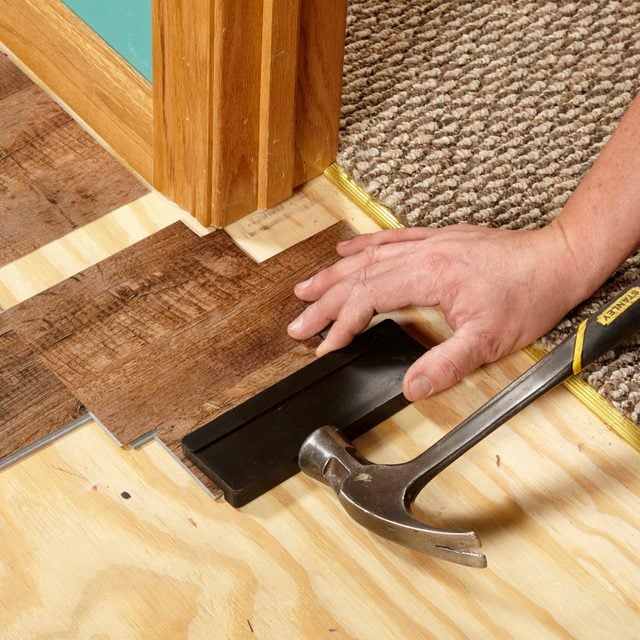
Sometimes you’ll have to cut around jambs while laying the planks perpendicular to a door opening. This is easy if the door opening falls on the same side as you started your rows. Simply mark and cut the first plank to size and tap it under the jamb with a tapping block.
Tap the end plank in sideways
It’s trickier to work around a jamb when the door opening is located at the end of the rows. One solution is to mark and cut the end plank to size, and tap it in along the end groove of the previous plank. You may not be able to lock it into place without removing the bottom lip on the plank you’re snapping it into. If you remove more than 6 in. of the lip, use seam sealer to glue the planks together. Buy a bottle of seam sealer for about ten dollars from your flooring supplier.

Install Shoe Molding
- Once your flooring is down, install shoe molding to cover the expansion gap between the flooring and the base trim.
- Shoot 1-1/4-inch finish nails through the shoe and into the base trim.
- Pro tip: Be careful not to pin the flooring down in the process. Finish the molding to match the trim, not the flooring.
