Chainsaw Reviews
Updated: Mar. 06, 2023How to choose the best chainsaw for your projects and budget, plus reviews of popular chainsaw models.
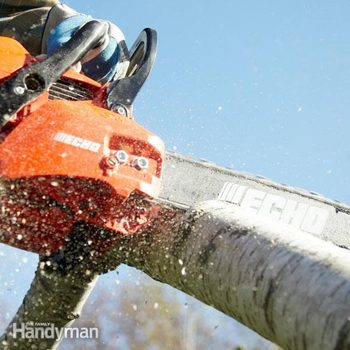






Overview: Chain saw reviews and best features
With the top four manufacturers offering more than 80 models combined, choosing the right chain saw can be a daunting task. To help you make a choice out of the best chainsaws, we divided the saws into two categories based on cost and engine size. Then we fired them up and made hundreds of cuts. We compared features and performance. Choose from the ones that best fit your particular needs and budget.
But first, especially if shopping for your first chainsaw, read through the chainsaw features we love. They’ll orient you to the key problem-solvers that manufacturers build into their products and make chainsaw use safer and easier.
Many of the features listed below, like tool-free chain tensioning, are found on the entire range of saws. Others, like an air pre-cleaning system, are only available on more expensive models. Go online or stop at your local dealer to pick up manufacturers’ literature that outlines the features and offers you comparison charts to help in your selection.
Feature 1: Tool-free chain tensioning
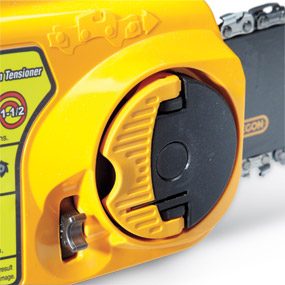
The chain on your saw has to be tensioned correctly. If it’s too loose or too tight, it can damage the bar and present a safety hazard. Without tool-free tensioning, adjusting the chain tension requires a wrench and screwdriver. With this innovation, you don’t need either.
Systems vary slightly among saws, but in general, the nuts that secure the bar to the saw’s body have been replaced by a mechanism built into the clutch cover. You loosen the bar by hand and then turn a knurled wheel of some sort to adjust the chain tension. We like this feature and think it’s worth spending a few extra dollars for.
Feature 2: Choke and on/off switch
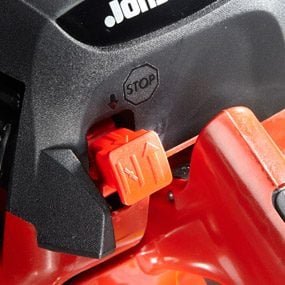
Starting a cold chain saw requires closing the choke and increasing the throttle speed. To stop the saw, you switch it off. Some saws combine all these functions in one switch. Others have separate on/off and choke switches.
We prefer the type of switch found on the Husqvarna and Jonsered saws because it’s large enough to operate easily with gloves on, pushing down on the switch stops the engine, and the switch automatically returns to the “run” position. You don’t have to switch the saw back on to start it again. This helps prevent accidentally flooding the engine by trying to restart it with the switch off.
Feature 3: Easy-start system
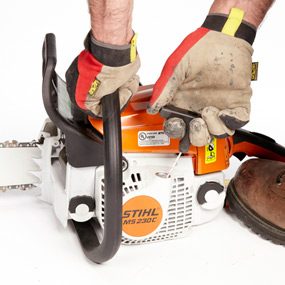
The bigger the engine, the harder it is to pull the starter cord, unless there’s some feature built in to reduce the starter cord tension. One innovative solution changes the spring mechanism in the recoil (the part that rewinds the starter cord) to make it easier to pull. Stihl’s Easy2Start system, which uses this mechanism, is surprisingly easy to pull, and works great. Other manufacturers have easy-start recoils too, but the difference isn’t as dramatic.
Another design that reduces starting effort opens a temporary hole in the cylinder to reduce compression, making it easier to pull the starter cord. Look for this decompression valve feature on larger chain saws.
Feature 4: Body width
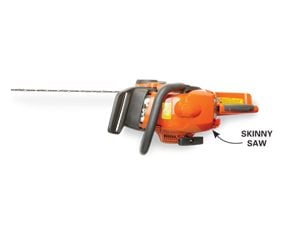
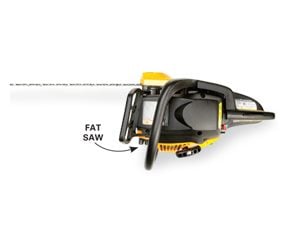
Pros who work with chain saws all day prefer compact saws. More expensive saws like the Husqvarnas, Jonsereds and Stihls have narrower bodies than some of the cheaper ones. The narrower body makes the saws easier to carry and to maneuver in tight spots.
Feature 5: Carbide-toothed chain
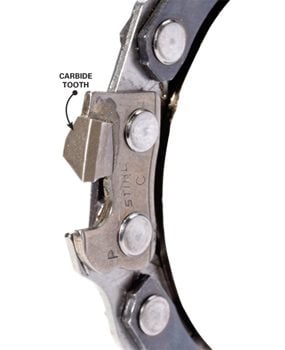
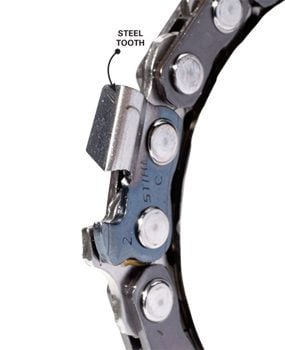
A dull chain cuts slowly, but worse, it can damage the chain and the bar as well as put extra strain on the saw. It only takes a fraction of a second to dull the blade if you touch the ground with the chain, saw dirty wood or hit a nail.
A chain with carbide tips, like the one you’ll find on the Stihl MS 230 C-BE, can withstand encounters with dirt and nails and still be sharp enough to keep cutting. You’ll pay an extra $50 or so for this feature, but if you cut dirty wood, need to cut stumps close to the ground, or cut a lot of “urban wood” that’s likely to have nails embedded in it, then this may be money well spent.
The downside is that you can’t easily sharpen a carbide chain yourself, and even sharpening shops may not have the equipment to do it. Before you buy a carbide-tipped chain, or a chain saw that includes one, find out if you can get it sharpened and how much it will cost.
Tough Enough to Keep Cutting
I used the carbide-tipped chain to cut a dozen weed trees flush to the ground. Sometimes the chain actually went into the dirt. It cut as well on the last tree as it did on the first.
Ken Collier, Editor in Chief
Other features: Anti-vibration, air purge, and more
Easy-access air filter
Every chain saw has an air filter connected to the carburetor, and if it gets clogged, your saw will waste gas, pollute more and perhaps run poorly. If you can access the air filter easily, without having to pull out a screwdriver, you’re more likely to keep it clean. Stihl saws have one of the easiest covers to remove.
Air purge
Most of these saws have a translucent, rubbery bulb that you press five or six times before you start the cold engine. It’s called an air purge or a primer bulb because it replaces the air in the gas line with fuel. This reduces the number of times you have to pull the starter cord, saving wear and tear on the saw and your arm.
Fuel gauge
On some saws, you can see the level of the fuel in the tank without removing the cap.
Easy-to-remove fuel and oil caps
Stihl chain saws have fuel and oil caps that you remove by flipping up a handle and twisting a quarter turn. Other saws include a raised “handle” that allows a better grip. Both are nice features.
Air precleaner system
Many of the more expensive saws have a precleaner system that throws out most of the larger dust particles before they reach the air filter. This reduces air filter maintenance and improves engine performance.
Anti-vibration
All but the cheapest chain saws have springs or rubber bushings that separate the handle assembly from the rest of the saw to reduce the amount of vibration you feel. The more expensive the saw, the more robust the springs or bushings are. We could feel the difference between the saws that didn’t have any springs or bushings and those that did.
6 Things You Should Know Before Buying a Chainsaw
1. Engine size is measured in cubic centimeters (cc) or cubic inches. In general, the bigger the number, the more powerful the engine. Most homeowners will do fine with a saw in the 32 cc to 45 cc range.
2. A bigger bar isn’t necessarily better. For most homeowners, a 16-in. bar is plenty. Longer bars can get in the way and increase the likelihood of dangerous kickback.
3. In general, more expensive saws have better components and will last longer, but most DIYers will never wear out even a less expensive saw.
4. Safety gear isn’t optional. You need a helmet with a face shield, hearing protection, leather gloves and special chain saw chaps. Expect to spend about $120 total for these items.
5. In many cases, you can buy the same saw with or without special features like tool-free chain tensioning. You can save money by forgoing a little convenience.
6. If you’re not experienced with chain saws, consider buying from a full-service dealer that can help you set up the saw and show you how to start it. For more details on safe saw use and safe cutting techniques, see Using a Chain Saw Safely.
Chainsaw brands and reviews: 3 Chain Saws for a Tight Budget
We limited this class of saws to a price point under $150, which means they’ll typically have an engine size under 40 cc. If you’re not heating with wood or cutting down 2-ft.-diameter trees, a chain saw in this category may be all you need. We tried three saws that cost under $150. Keep in mind that if you increase your budget to $200, you’ll have a lot more choices, which will include saws from Stihl, Echo, Husqvarna and Jonsered.
Review 1: Homelite UT10560
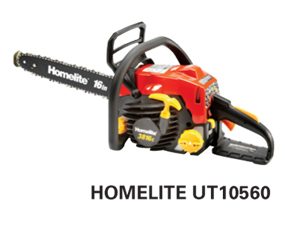
This saw has many nice features including an air purge, springs for vibration control, tool-free chain tensioner and see-through gas and oil reservoirs, and it comes with a case. We found the tool-free mechanism slightly harder to use than most and the clearance between the handle and the chain brake a little tight. Online reviews are mixed, but our test saw ran smoothly.
Review 2: Poulan P3816
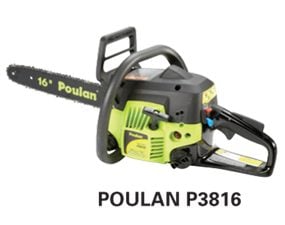
Like the Craftsman (below), this saw includes an air purge bulb and comes with a case. It doesn’t have the tool-free chain tensioner but does have a chain tensioner built into the bar that’s easier to access than more-conventional chain tension adjusters. You have to remove screws to access the air filter. We like the big grips on the fuel and oil filler caps but don’t like the fact that there’s no vibration dampening built into the handle. For the same price, the Craftsman offers the additional tool-free chain tensioner.
Review 3: Craftsman 35170
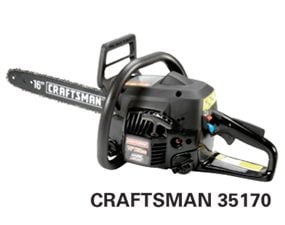
This Craftsman saw appears to be identical to the Poulan P3816 (above) except the Craftsman has the tool-free chain tensioner. The saw has an air purge and includes a carrying case. We had a little harder time starting this saw than we had with some of the more expensive models. We don’t like the lack of vibration dampening in the handle of this saw. Otherwise it’s a good value and worth considering in the under-$150 price range.
Gearhead’s Guide to What’s Under the Hood
Ever wonder why one chain saw costs 30 percent more than another comparably sized saw? Here’s a list of the features you’ll find on more expensive saws:
- Two- or three-piece crankshaft vs. five-piece cranks means less vibration and longer life.
- Forged rather than stamped connecting rods. Forged rods are stronger.
- Centrifugal precleaner built into the flywheel means better airflow for better engine performance.
- Chrome-impregnated vs. chrome-plated cylinders. Chrome-impregnated cylinders have microscopic pores that hold oil to help lubricate the piston.
Saw reviews: 4 chain saws for medium-duty use
We limited this class to a price point under $350 with engines about 40 cc. If you cut wood several times a month, want a saw that doesn’t struggle when cutting at full capacity, or just like to buy top-quality tools, then this is the category for you. Saws in this range often include all of the quality components and features of more expensive chain saws. They just aren’t quite as powerful.
Review 4: Stihl MS 230 C-BE
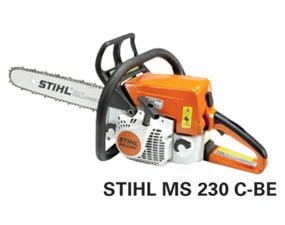
This saw is loaded with every feature you could want, plus it comes standard with Stihl’s Duro carbide-tipped chain. But what really sets it apart is the Easy2Start system. A gentle, steady pull on the starter rope winds a spring that releases when it overcomes the compression pressure, turning over the engine. It’s noticeably easier to pull, without the jerkiness you normally feel.
We also like that the air cleaner cover and gas and oil caps are easy to take off and replace without tools. For an extra $50 over similar-size saws, you get a chain saw that’s super easy to start and includes a carbide-tipped chain.
Review 5: Jonsered CS 2240 S
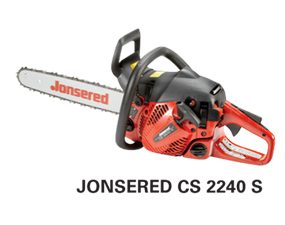
You can’t go wrong buying a Jonsered saw. Jonsered offers models in all but the lowest price range. This saw includes a tool-free chain tensioner, a spring-assisted starter cord, an air filter precleaning system, a press-down- to-stop and return-to-start switch, a fuel level indicator and robust springs for vibration dampening. The saw starts easily, runs smooth and cuts fast. We couldn’t find any fault with this saw.
Review 6: Husqvarna 440 e-series
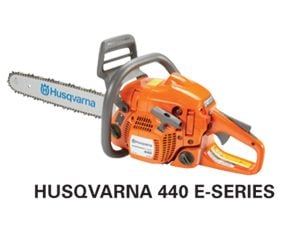
As with the Jonsered, you can buy a Husqvarna with confidence, knowing that you’re getting one of the best chain saws on the market.
In fact, under the cover, this saw looks identical to the CS 2240 S and has all the same features (see Jonsered’s CS 2240 S above). We couldn‘t discern any difference in the way the two saws start, run and cut. The tool-free tensioner on both of these saws is outstanding. There’s a large handle that flips out to give you extra leverage, and the adjuster has “teeth” that are large enough to work with gloves on.
If you’re trying to decide between the Jonsered CS 2240 S and this saw, we recommend you choose the one that’s available at a local dealer. The Husqvarna narrowly edged out the nearly identical Jonsered for our Editors’ Choice only because the retail price was $10 less.
Review 7: Echo CS-400
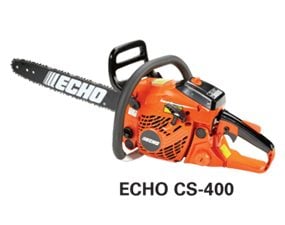
Here’s another top-quality saw from a respected name in outdoor power equipment. The Echo CS-400 includes an air purge bulb, air precleaner and an air cleaner cover that’s easy to remove without tools. This saw lacks a tool-free chain tensioner but does have an easy-start system that works well.
There’s a small toggle switch to turn the engine on and off and a separate choke lever. The saw has rubber bushings rather than springs for vibration dampening. It starts easily and runs great. Unless you can find this saw on sale, however, we recommend either the Jonsered or the Husqvarna because they have better features for the same price.
Saw reviews: 3 chain saws for heavy-duty use
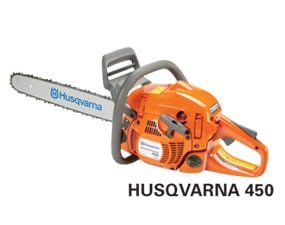
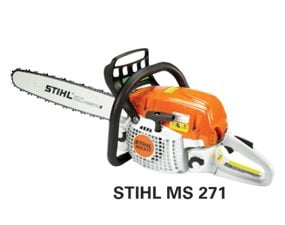
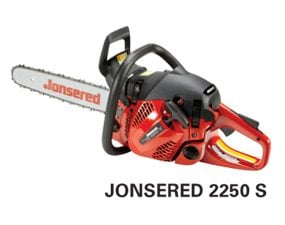
This class includes saws that cost $350 to $600 with engines larger than 40 cc. If you own acres of land and spend a lot of time on tree cutting and cleanup, spending a little more for a chain saw makes sense. Saws in this category have the best-quality components and are made to withstand daily use. Plus, you can get bigger engines capable of handling longer bars. The three saws here are typical for this range.