Overview: Benefits, time and cost
When a deck is inviting,
you know it, and here's
one that will definitely
draw you outdoors. It's spacious and
attractive. It features large planters to put
green plants and flowers close at hand.
And it has a versatile railing system that
lets you combine solid panels for privacy
and open sections for great views and
cooling breezes.
We framed the deck with pressure-treated
wood, which will last for decades,
and then covered the framing with plastic/
wood composite decking and an engineered
wood trim, aluminum balusters
and fiber cement siding (more on these
later).With these materials, your deck will
look great for a decade with little more
than an occasional cleaning.
In this article, we'll show you in detail
how to build the unique features of the
deck: the planters and the railings.
We won't go into as much detail on the
framing, although the drawings provide
all the necessary details for you to complete
the project.
A deck project of this size is an entire
summer commitment, so getting the planning
done now will give you more time to
enjoy it later in the season. Despite its size,
the project is no more difficult than an
average deck, so if you're an intermediate
do-it-yourselfer, you'll be able to tackle it.
Low-maintenance materials come with
a higher price tag (about 30 percent more
than wood), but the extra years of service
more than offset the difference. We paid
about $7,500 for the materials for this
12 x 30-ft. deck.
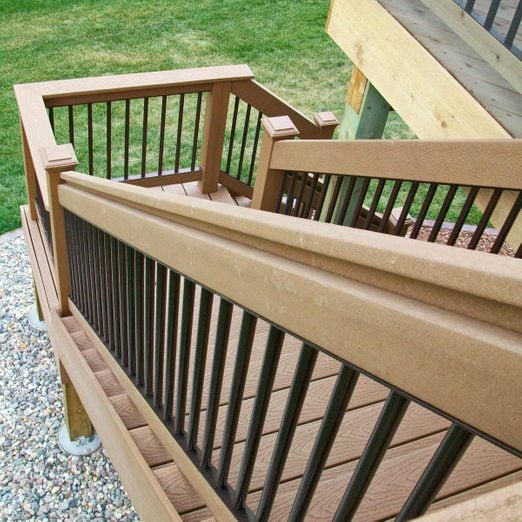
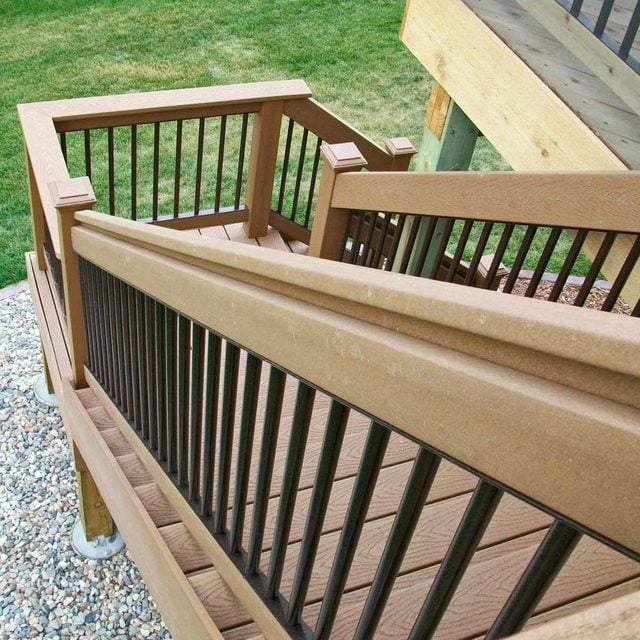
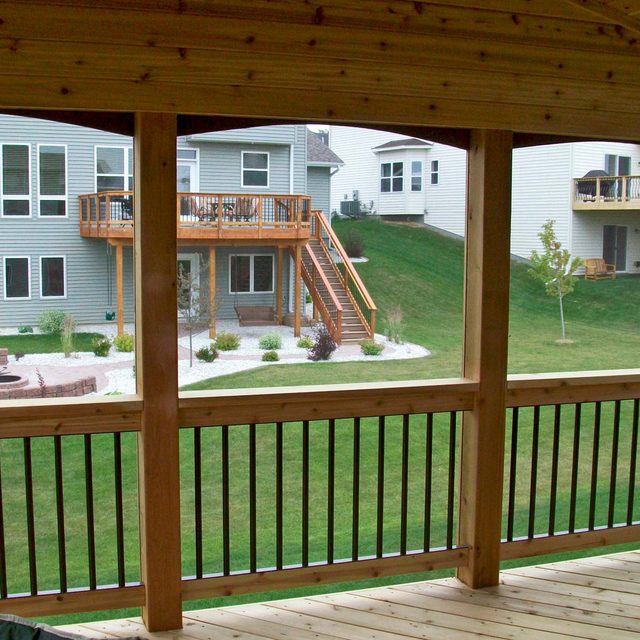
Spacious deck, viewed from below
Spacious, Semi-Private Deck
This deck spans the back of the house. Large planters provide partial privacy, while the open railing sections offer nice views. It has several low maintenance features listed below. Tall plants help it blend with the yard.
Key low maintenance features
1 of 4
Composite decking, railing and caps
Durable all-weather composite
decking and boards are used
on all flat surfaces.
2 of 4
Fiber cement lap siding
This pre-primed siding is
impervious to rot and decay
and holds paint like a magnet.
3 of 4
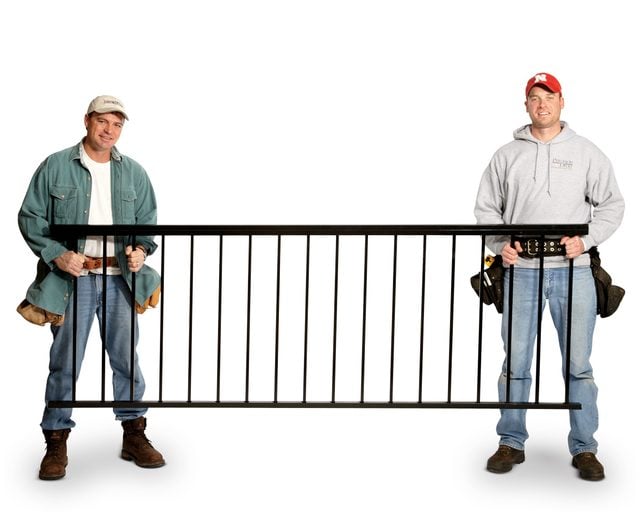
Aluminum balusters
Cut these factory-painted
tubes to length and install
them into the rails.
4 of 4
Engineered wood trim
Engineered wood composites
cut and nail easily and stand
up to the weather.
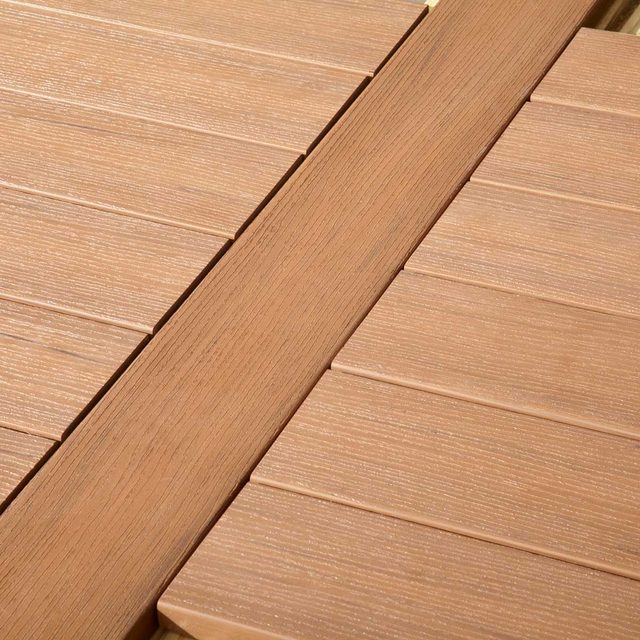
For the decking, we chose Trex, one of the many composite materials available.
A big advantage is that it's available in standard decking sizes (2x6 and
5/4 x 6) as well as in 3/4-in.-thick boards that work well for outdoor trim.
We used it on all the weather-vulnerable horizontal surfaces, including the
rail and caps, since it's virtually unaffected by water.
For the trim pieces where we wanted to add color with paint, we used
an engineered composite called Miratec (one of several similar products).
It's highly water resistant and can be cut and nailed just like wood.
And for the lap siding on the planters and the panels we chose fiber
cement, a product now widely available. It's heavy but it won't rot, and it
holds paint extremely well. You'll be able to find this and the other products
at your local lumberyard and home center.
Step 1: Draw up a good plan to save time and money
You'll no doubt have to modify our deck plans
to fit your house, so here are some things to
consider along with other planning issues:
- Sketch your house with your window and
door locations as well as your lot lines so
you'll be able to adapt the deck size.
- Consider the location of the stairway. You
may need to change it to the side or even
the front.
- Take a detailed sketch of your plan, including
all the structural information, to your
local building department for a permit,
and be sure to get your underground utilities
marked before digging.
- Lumberyards may need to special-order
some materials like composite decking or
balusters so
check with your supplier at least three
weeks before you plan to build.
Figure A: Deck Overview
This deck plan shows the basic deck parts and the framing details. See Figures B, C and D for planter, railing and staircase details. Figure A is also available as a pdf in “Additional Information” below.
Step 2: Lay out and dig the footings
You'll need to lay out the concrete footings
and anchors (Figure A) precisely, because
the posts that attach to the footings are an
integral part of the railing above. Measure out
from the house 140-3/4 in. in two spots and
run a string line exactly parallel to the house.
The first footing location (Photo 2 below) must
be square with the house along this line, so
use the 3-4-5 triangle method to triangulate
it precisely.
- Stake the location of the center of the
first footing and then measure along
your string to locate the centers of the
others. Keep the measurements an equal
distance from each other for uniform
railing sections.
- If you locate the stairs at the same spot we
did, make sure the post adjacent to the
stairway aligns with the house (Figure A,
Detail 3), so you can attach the ledger to it.
- The design requires accurate positioning of
the posts, so double-check your measurements
to make sure they're square and
parallel. If a utility marker shows that an
electrical, phone or gas line is in the way,
revise your layout.
- Consider renting a power auger to dig the
footings to frost depth. Make the hole a bit
wider at the bottom for a solid base. Once
the holes are dug and inspected, mix the
concrete in a tub and fill each hole. Our
holes required about six 80-lb. bags of concrete
mix each. Use short sections of
Sonotubes (12-in.-diameter cardboard
tubes) to form the tops of the footings a
few inches above grade. Before the concrete
hardens, add a 1/2-in.-diameter
anchor bolt at the center of the footing
with 1 in. of the threads exposed. Let the
concrete set for two days before you set the
posts (Photo 2).
Step 3: Attach the ledger and set the posts
1 of 3
Photo 1: Install the ledger
Remove the lower
two or three courses
of siding to reveal the
rim joist of the house,
then measure the length
of the ledger. Fasten
the ledger to the rim
joist with 1/2-in. x 4-in.
galvanized lag screws.
2 of 3
Photo 1A: Bolt positions
Position the ledger bolts every 8 in. in a staggered pattern for strength.
3 of 3
Photo 2: Pour the footings and set the posts
Lay out the post
positions with
string lines and pour
the footings. Anchor
and brace the posts.
Screw a cleat to one
end of an uncut joist,
lay it on the ledger,
level it, and mark the
top and bottom joist
heights onto each post.
The ledger supports half the weight of the
deck, so be sure to anchor it with 1/2-in. x
4-in. galvanized lag screws every 8 in.
- First check the condition of the rim joist
on the house (Photo 1) to make sure it's
rot free.
- Cut 12-in.-wide strips of No. 15 roofing
felt and staple them to the house rim. Tack
the 2x10 treated ledger into place with 16d
nails and then mark the joist layout on the
ledger.
- Drill pilot holes for your lag screws so they
won't interfere with your joist layout, then
drive the lag screws.
- Bolt the galvanized steel post brackets to
the anchor bolts at the top of the footings.
Stretch a string parallel to the house again
so you can perfectly align the post anchors.
- Lift the 6x6 treated posts onto each post
anchor and nail temporary braces onto the
post. Screw the base of the post into the
anchor, and plumb the posts by driving
stakes into the ground and screwing the
braces from the post to the stake (Photo 2).
Step 4: Install the rim joists and regular joists
1 of 2
Photo 3: Nail up the rim joists
Nail the double rim
joist and the side
rim joists to the posts.
Then cut and nail 2x6
vertical supports below
the outer rim (see
Figure A).
2 of 2
Photo 4: Hang the regular joists and bolt the rims
Nail up the joists
using joist hangers.
Then tack the outer
rim joist even with
the inner rim joist
and drill a recess and
a clearance hole for
the 1/2-in. x 10-in.
galvanized carriage
bolts. Insert and
tighten the bolts.
Now you'll want to mark the inner rim joist
location onto the posts (Photo 2). This can
be tricky, so to make the job easier, cut a 6-in.
piece of 1x2 and screw it to the top of a joist,
leaving 1-1/2 in. protruding. Now you can
rest this cleat atop the ledger while you mark
the rim joist locations on each post.
- Next, cut pairs of inner rim joists to fit
inside the posts. Measure these lengths at
the bottom of the posts because the upper
part of the post could be slightly out of
plumb at this stage. Tack these inner rim
joists to the posts with a pair of 16d nails,
making sure they won't interfere with the
bolts that you'll install later.
- Transfer the joist layout from the ledger
board to this inner joist.
- Next, cut the treated 2x6 vertical rim supports
(Photo 3) and nail them with a pair
of 16d galvanized nails every 10 in. to the
inside face of the posts to support the joists
above. These rim supports should be in contact
with the top of the concrete footing.
- Cut your joists to length and screw a 1x2 to
the top of each end as shown to support
them, and set each joist on layout and
secure them with joist hangers.
- To finish the deck framing, you'll need to
add the outer 2x10 treated rim joist.
- Remember to slip a strip of metal flashing
under the siding and building paper and
over the ledger as shown in Figure A.
Step 5: Fasten the decking with trim screws
1 of 2
Photo 5: Install the decking
Screw the decking
to the tops of the
joists, leaving a
1-1/2-in. overhang on
the front and sides.
Use special self-drilling
trim screws.
2 of 2
Photo 6: Lay decking straight
Snap lines every
3 ft. as guidelines
to make sure the
decking courses run
straight. Cut 3/16-in.-
thick spacers for
accurate spacing and
stagger end joints.
We used special self-tapping trim screws to fasten
the decking to the joists. The slim profile
and small heads allow you to sink them just
below the surface for a nice, clean look (Photo
6).
- Start the decking at the outer edge of the
deck (Photo 5).
- You don't have to fit the decking tight
around the posts because the posts will be
built out later. If you have to install the
decking up to a wall, maintain a 1/4-in. gap
to allow for expansion in warm weather.
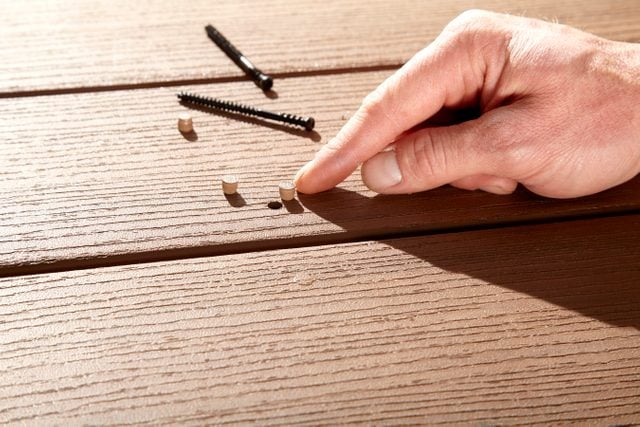
- Drive the screws 1/8 in. below the surface
of the decking. This will pucker the decking
slightly. Flatten the dimpled surface
with a blow from a smooth-faced hammer
to make the screw hole nearly invisible.
- Buy about six or more extra Torx driver
bits because you'll probably strip or break
a few of them.
Step 6: Build the planters
1 of 2
Photo 7: Build the outer walls
Cut the posts to
length. Then screw
the 2x4 outriggers to
each post (Figure B). Build the outer
planter walls from 2x4s
and 3/4-in. plywood
and screw them to
the outriggers.
2 of 2
Photo 8: Build the inner walls
Build the inner
planter walls in
two short sections and
screw them to the
outriggers. Then screw
3/4-in. plywood side
panels into place to
enclose the planters.
Now that the basic deck is framed and decked, it's time to build
out the planters using the 6x6 post as the core. First, measure up
28 in. from the decking on each 6x6 post (Figure B), use a square
to mark all four sides and cut the posts along the mark. Your circular
saw won't cut through completely, so finish the cut with
your handsaw.
To build the posts out to the larger dimensions of the planter,
you'll need to build four sets of outriggers for each post. These
outriggers are cut from treated 2x4s and screwed to each post with
3-in. galvanized deck screws. Keep the bottom outrigger set 1-1/2
in. above the brackets.
Next, cut 22-in.-wide pieces from 3/4-in. treated plywood to use
as sheathing for the front and rear of the planters. Measure the
lengths of plywood so they'll be flush with the bottom outrigger
and then extend 40-1/4 in. above the decking. Complete these
front and rear panels by screwing a pair of treated 2x4s at the outer
edges (Photo 7). You'll notice that our length was a bit over 8 ft.,
so we added a piece of plywood to fill later. Screw the plywood
panel to the outriggers. Make the inner section of the planter in
two separate pieces (one above the deck and one below). Check the
positioning of each panel with a framing square to make sure the
planter box will be square when you finish it. With the front and
rear plywood panels screwed into place, cut and screw the side
panels into place to complete the box. Finally, cut lengths of 2x4 to
fit between the upright 2x4s of each box to support the trim at the
top. Cut 2x6 blocks to support the railing (Figure B).
Figure B: Planter details
Figure B: Planter Details
Figure B is also available as a pdf in “Additional Information” below.
Step 7: Add trim to the planters
1 of 1
Photo 9: Trim the planters
Trim the top sides
of the planters with
3/4-in.-thick Miratec
composite boards and
cap the planters with
5/4 x 6 Trex decking
screwed to the trim.
The tops of the planters are first
trimmed with Miratec boards. This trim
is nailed to the perimeter of the top and
then ripped and cut to make the corners
of the planters. The very top and the
bottom of each planter are trimmed
with Trex material, which is even more
water resistant. This composite will
withstand the moisture rigors of rain
and plants at both the bottom and the
top of the planters. Be sure to screw
each layer at the top and bottom with
the decking trim screws. Check the size
of your plastic pots and make the trim
at the top fit snugly around the rim of
the pot.
Now rip 3/4-in. Trex boards to 5-1/2-
in.-wide, and cut them to fit at the bottom
of the planters. You may need to
taper these trim pieces to follow the
grade (Photo 13), making sure they're
above the ground 1-1/2 in. Then make
corner boards from the 3/4-in. trim as
shown in Photo 13 and nail the trim to
the corners of each planter.
Step 8: Assemble the open railings
1 of 4
Photo 10: Drill the rails
Drill the holes
through the top
and bottom rails for the
aluminum tube balusters.
Use an adjustable auger
bit for holes slightly
larger than 3/4 in.
2 of 4
Photo 10A: Close-up of auger bit
The adjustable bit allows you to make a hole to exactly fit the aluminum baluster.
3 of 4
Photo 11: Assemble the rail
Cut and screw
on 2x4 subrails.
Then fit the rail section
between them. Center
the rails and then screw
the rails to the subrails
(see Figure C, below).
4 of 4
Photo 12: Trim the railing
Cover the railing
side joints with
trim pieces. Secure the
bottom center of each
railing section with a
treated 2x4 block
screwed into place
from above and below.
First measure between the planters and
then cut top and bottom subrails from
straight 2x4 treated wood (Photo 11).
These are the structural supports for
the railing system. Set 4-in.-long spacers
under the lower subrail, then center
the subrail in the planter side and toe screw
the bottom of it into the planter
on each end. Screw the top subrail into
the planter sides so the top of it rests
just under the trim as shown in Figure
C.
To make the balustrade insert
between the subrails (Photo 10), rip a
3/4-in. x 6-in.-wide Trex board for the
bottom rail and another the width of
the 2x4 (ours was a fat 3-5/8 in.) for the
top. Lay out the baluster positions
every 4-1/2 in. on center for the 3/4-
in.-plus holes. Set your adjustable
auger bit (Photo 10) so it will drill a
hole just large enough to allow the
metal baluster tube to slide freely.
Tip:
Drill the holes through the Trex board
and into sacrificial plywood backer
below to avoid tear-out around the
hole.
Also cut your aluminum balusters to
length with a 40-tooth carbide blade in a circular
saw.
Now you can partially assemble the rail
before fastening it to the subrails. First, apply
1-1/2-in. tape to the underside of the lower rail
to close off the drilled holes. Stack the upper
rail over the lower so the holes match and then
insert the tubes. Pull the upper rail slowly and
deliberately up along the tubes until it's near
the top. The friction will hold the top rail in
position as you carefully insert the balustrade
(Photo 11), center it on the subrails and then
screw it in place with 1-1/2-in. decking screws.
Next, cover the top of the upper subrails with
a 3/4-in. Trex board ripped to 6 in. wide. To
cover the joints between the rails and subrails,
rip trim pieces (Photo 12 and Figure C), then
nail them on with your finish nailer.
Figure C: Railing details
Figure C: Railing Details
Figure C is also available as a pdf in “Additional Information” below.
Step 9: Build the solid end panels
1 of 3
Photo 13: Trim the plywood boxes
Trim the plywood
planter
boxes at the bottom
with 3/4-in. Trex
boards. Trim the vertical
corners with ripped
lengths of Miratec trim.
2 of 3
Photo 14: Build the railing end panels
Frame the solid
end panels with
the treated 2x4 top subrails
and a treated 2x4
fastened to the deck
with 3-in. galvanized
screws. Add 3/4-in.
plywood to cover
the sides.
3 of 3
Photo 15: Finish trimming the railing
Trim the inside
faces of the 2x4
frame, then install the
lower 2x4 subrail,
baluster assembly and
trim. Cap the panel
with a wider 3/4-in. x
7-1/4-in. Trex board.
To add extra privacy at the ends of the deck,
build 2-ft.-wide walls extending from the
planters and from the house (Figure A). Use
the top subrail as the top plate of these walls
(Photo 14 and Figure C).
To make the trimming easier here, cap the
ends of the short walls with trim, and then
install the lower 2x4 subrail over the trim.
Make the balustrade the same way as before
and then add a 7-1/4-in.-wide railing cap
instead of the 6-in.-wide cap that you used
for the other rails. Trim the rest of the panels
as shown in Figure C and Photo 15.
Step 10: Nail cement siding to the panels and planters
1 of 1
Photo 16: Install fiber cement board
Cut cement
board siding to
fit between the trim
pieces, leaving a
1/16-in. gap at each
end. Use galvanized
siding nails and a
pneumatic nail gun to
secure the siding to
the plywood.
Cut the cement siding with a dry diamond
blade in your circular saw. You must wear a
good-quality dust mask and safety glasses
and pay attention to which way the wind is
blowing. This stuff really kicks up the dust as
you cut it. And if your neighbor's convertible
is downwind, ask her if you can move it
before you cut.
Fitting the siding around all the railing
parts is definitely tedious. A jigsaw will help
you make the intricate cuts, and a sharp
wood chisel will let you knock out hard-to-cut
sections. Fasten the siding to the plywood
with a framing nailer fitted with galvanized
siding nails (Photo 16). Adjust the pressure
of your compressor to set the nail head flush
with the surface of the siding. Caulk all the
joints with siliconized acrylic caulk when
you've completed the siding.
Step 11: Build the stairway and paint
1 of 1
Photo 17: Assemble the stairway
Cut your stair
carriages from
2x12 treated wood,
making sure the span
between the carriages
is no more than 16 in.
Position the end carriage
on the column so
it aligns with the deck
joist on the opposite
side of the column.
See Figure D for details.
Because you're using composite decking for
the stair treads, you'll need to cut enough carriages
to support it at least every 16 in. on
center. Each stairway will be unique to each
deck, of course, but the basic construction
process shown in Figure D remains the same.
To make the railing complement the other
guardrails of the deck, we made the stairway
wider than necessary. The outer carriage that
fits against the planter box is exactly the same
as the other carriages but is cut short at the
top. Make sure it aligns with the rim joist of
the deck on the other side of the planter. Cut
riser boards from a 1x8 Trex board and cut
the stair treads from 5/4 x 6 decking. We
placed an additional hand railing against
the house for a continuous grip from top to
bottom. Note:The stair balusters are not
drilled into place like the other balusters but
are held with special heavy-duty angled
plastic connectors.
Paint parts of your deck
to match your house
The cement siding and Miratec trim are
already primed, so spot-prime any cut ends or
nail heads and then paint the trim to match
the house. The Trex material can be painted as
well. We painted the Trex boards at the base of
the planters and the risers of the stairway. The
rest of the Trex pieces have a warm natural
color that may fade a bit over the years but will
be maintenance free.
Figure D: Staircase details
Figure D: Staircase Details
Figure D is also available as a pdf in “Additional Information” below.
Back to Top