How to Choose Joint Compound
Updated: May 01, 2023Finding the right type for your project






What joint compound to use when taping and repairing
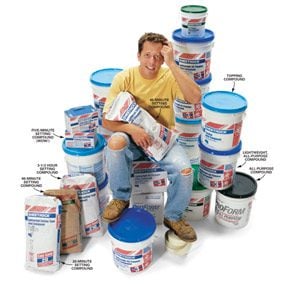
For starters, buy a bag of 45- minute setting drywall compound; you’ll find it in 30-lb. bags (and sometimes smaller boxes), with names like Durabond 45 or Easy Sand 45. It comes as a powder—mostly plaster of Paris—you mix with water as you need it. It hardens quickly (you guessed it, in 45 minutes), shrinks very little and dries hard as a rock. This makes it ideal for filling oversize cutouts around electrical boxes, nail and screw dimples and cracks in areas where drywall sheets don’t butt tightly. And since it dries quickly, you can move on to the “real” taping without waiting. Buy an “easy-sand” variety; the standard stuff dries so hard you can spend hours sanding ridges left behind by your trowel. Make sure to clean your tools off pronto when you’re done unless you want a sculpture titled “Drywall Knife Stuck in Pan.” Freeze your leftover drywall compound to reuse it again.
For embedding the tape and the subsequent layers, buy lightweight, all-purpose joint compound in the familiar (and ever-so-useful) 5-gallon bucket. This drying compound hardens through evaporation—which means waiting up to 24 hours between coats. Apply it full strength across the joints and at corners for bedding the tape. Then use it full strength or slightly thinned for the top layers. Try to avoid ridges and bumps with all purpose joint compound. But if you get them, don’t worry; the lightweight compound sands easily. It also scratches easily, so get a coat of primer on it as soon as you can. All purpose joint compounds is worth the extra buck per 5 gallons you’ll pay for it. A 5-gallon bucket will finish about 450 sq. ft. of drywall, the equivalent of fifteen 4×8 sheets.
What’s all the other stuff on the shelves? Topping compounds are “soupy” and contain less adhesive than all-purpose compounds. This makes them easy to feather and sand and thus ideal for the final coat or coats. Some pros are fond of this stuff, but for small jobs, all-purpose is fine. The five- and 20- minute setting compounds are used by pros for filling gaps, bedding tape, sometimes even for topcoats. Time is money for these folks; they can get away with using fast-setting compounds because they know how to apply them quickly and smoothly with very little sanding. But if you’re a rookie, stay clear of these; they’ll harden before you can walk across the room!