How To Choose Twist Drill Bits
Updated: Jul. 13, 2022Drill bits go head to head to see which is really best






How We Tested the Twist Drill Bits
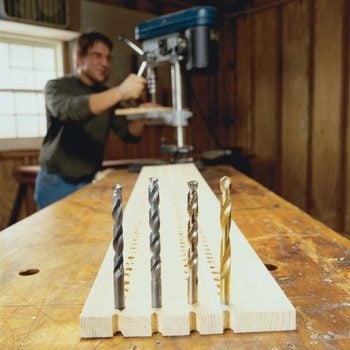
For this test, all you’ll need is a drill bit set. We tested four types of 3/8-in. twist drill bits. None of these four 3/8-in. bits dulled appreciably after drilling 160 holes through oak, pine, MDF, aluminum and 3/16-in. mild steel. The primary difference was in how true the holes were in the aluminum and how long each drill bit lasted in the final torture test.
Twist Drill Bit Test Results
I headed into my highly sophisticated drill analysis laboratory (my garage) and scientifically tested four types of 3/8-in. twist bits: a $2.75 high-speed steel bit, a $6 “black oxide” bit, a $7 cobalt bit and a $9.50 titanium bit. Using each twist drill bit in a drill press, I drilled 75 holes in pine, 40 holes in oak, 20 holes in aluminum tubing, 20 holes in medium-density fiberboard and five holes in 3/16-in. mild steel.
All of them finished the test without dulling appreciably. The high-speed steel bit was a little choppy on the last 20 holes in the pine, and all the bits except the titanium one tended to wander and bore oversized holes in the aluminum. But if you’re a less-than-160-hole-drilling do-it-yourselfer, working mainly in wood, you can get by with any of them. As one carpenter put it, “In my book it doesn’t really matter—I usually lose them or snap them in two before they have a chance to dull.”
To complete the test, I drilled holes in the steel with each until they dulled and became useless. The score? The high-speed steel bit was shot after 20 holes. The cobalt and black oxide bits were still boring after 25 additional holes, but with substantial effort on my part. The titanium bit just kept drilling an endless line of perfect holes—my arm gave out before the bit did.
Note: A bit’s composition isn’t the sole determinant in how well it bores through metal. In general, bits with “flatter” tips drill quicker, last longer and have less “walk” than those with “pointier” tips.
Required Tools for this Project
Have the necessary tools for this DIY project lined up before you start—you’ll save time and frustration.
- Drill bit set