Oriented Strand Board (OSB board) vs. Plywood
Updated: Aug. 25, 2021OSB vs plywood: Is one better than the other for sheathing?






Choosing sheathing: OSB vs Plywood
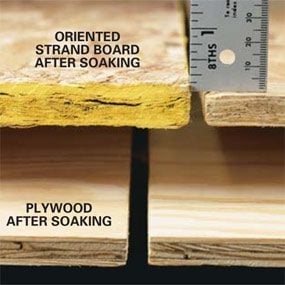
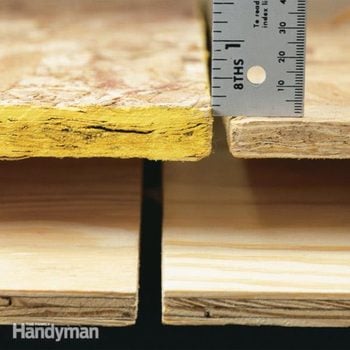
OSB vs Plywood: Water Test
The edges of the 1/2-in. oriented strand board (OSB board) that soaked in my bathtub overnight swelled almost 1/4 in. (and stayed swollen), while the plywood remained stable. The lesson? Don’t store OSB in a full bathtub. Kept high and dry during storage and after installation, OSB has the same strength and durability as plywood but costs less.
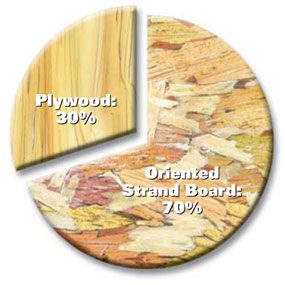
Building codes, the Engineered Wood Association, architects and most builders rate plywood and oriented strand board (OBS sheathing) equal in strength and durability. Like-thicknesses of these two products can span the same distances between studs or rafters, weigh about the same and offer similar nail-holding abilities.
OSB has its advantages. Some panels have a textured surface, which makes them less slippery when used for roof sheathing. OSB panels often have lines at 16- and 24-in. intervals so you know where underlying studs, rafters and joists are for nailing. In our area, 1/2-in. OSB sheathing costs a few dollars less per sheet than 1/2-in. plywood. And OSB is available in 4 x 9-ft. sheets, which means you can sheathe an 8-ft. tall wall and the joists below with a single sheet.
OSB sheathing has one irritating characteristic—but only if you abuse the stuff. The edges tend to swell when they get wet and remain swollen even after drying out. This results in ridges that can “telegraph” through shingles, and even carpet when OSB sheathing is used for subfloors. So store your OSB wood in a dry place, then cover it with tarpaper or siding ASAP to protect it from the elements.