Home Soundproofing
Updated: Sep. 25, 2023Tips for a quieter home







A few simple concepts about noise
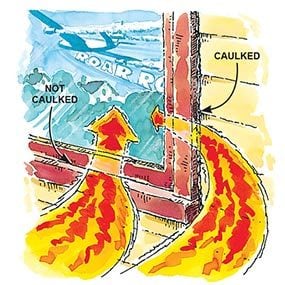
Fig. B: How to Soundproof a Room from the Outside: Eliminate gaps
The continuous, tight bead of caulk on the side of the window blocks noise, while the uncaulked lower edge lets sound enter unabated.
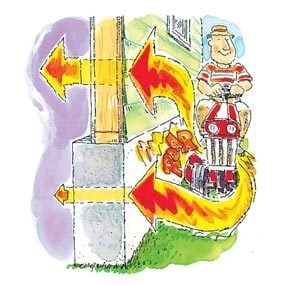
Fig. C: How to Soundproof a Room from the Outside: Use more mass
Because of its greater mass, the poured concrete lower wall is less prone to vibrate and will block more sound than the lightweight upper wall—even when insulated.
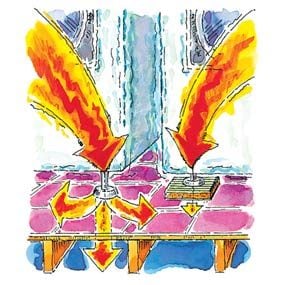
Fig. D: Isolate vibration
The small cork or rubber pad helps isolate the vibration of the washing machine (right), while the dryer leg resting directly on the floor passes vibration (and noise) on.
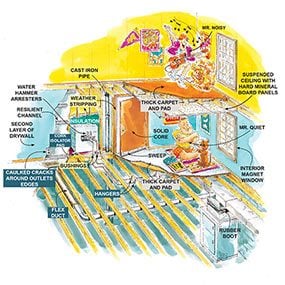
Fig. E: Quiet Interior Noise
Diminish noise levels using a variety of techniques, including sealing off airborne sound paths, adding mass to walls and isolating sounds generated via the plumbing and heating systems.
Noise is simply airborne vibration. What we perceive as noise traveling “through” a wall or other object is actually sound waves causing the wall to vibrate, then this vibrating wall making the air on its other side vibrate. Regardless of how it travels, noise reaches its final destination— our ears—as airborne sound. That’s what ears are, vibration receivers. Since noise travels primarily through air, the best way to block it is to put something in its path. To be most effective at blocking sound, the material needs three qualities. It should be gapless (Fig. B), since sound will sneak through even the smallest cracks and holes. It should have a lot of mass (Fig. C), so it’s less prone to vibrate and pass noisy vibrations on to its other side. And last, it should help isolate sound (Fig. D) so vibrations aren’t directly passed on from one object or place to another. There are a few other facts (and misconceptions) about noise that are important to understand. While you’re at it, learn if putty pads help with soundproofing.
- Although fiberglass and other types of insulation are great heat and cold insulators, they’re fairly mediocre sound insulators. They lack mass. Fiberglass insulation will help reduce noise transmission through exterior and interior walls when meticulously cut and fitted around and behind wires, pipes and electrical boxes. But to be even moderately effective, all holes and cracks must be sealed with a heavy material like caulk or plaster. And to be really effective, fiberglass insulation needs to be coupled with other methods used for soundproofing a wall.
- Metal beams, ducts and pipes vibrate easily and carry impact noises from one end to the other. To reduce noise, use rubber or resilient materials to support them. You can also help confine noise by creating a break in the material: Install two short beams with a small space between instead of one long beam, or install a rubber boot or flex duct in the heating system as shown in Fig. E.
- Soft, dense materials, like heavy curtains, stuffed furniture and thick carpet, will make the room they’re in quieter and less echo-y and slightly reduce the noise transmitted to other rooms.
The concepts are pretty simple. But things start getting complicated when we apply these ideas to our houses.
A Quiet Home vs. a Noisy Home
In a whimsical 1970s tune,“One Man’s Ceiling Is Another Man’s Floor,” songwriter Paul Simon bemoaned the noisy fate of apartment dwellers. But even those of us who live in houses can relate to the gist of the song; the world around us is noisy!
When Ray next door practices his duck calls at 7 a.m. or your teenager practices her bassoon solo at 11 p.m. or a jumbo 757 takes off over your house at dawn, you’d just as soon hear the sounds of silence.
Here we’ll explain the basics of noise transmission, plus give you some ideas on how to make your home quieter.
A very quiet, very uncomfortable solid concrete home
Taking things to an extreme, you could build a house that would shut out most outside noise. You could erect four solid concrete walls on a concrete slab, cap them with a concrete roof, then cover the whole house with earth. The concrete wouldn’t have gaps for sound to slip through, the massive walls wouldn’t vibrate and pass on outside noise, and the earth would isolate the house from impact-type noises. You could catch some serious ZZZZs in a house like that.
But you’d need a way in, so you’d add a door. And you’d want light and fresh air, so you’d add windows. And you’d cut in vents for your dryer and bath fan; you’d add a chimney for your furnace. And since concrete walls aren’t all that homey, you might replace one or two with wood-framed walls with cedar siding and knotty pine paneling. All of a sudden, your solid, quiet house contains holes and “thin spots” that sound can travel through. And, of course, the people inside your silent dream home aren’t always quiet either. Bammm, welcome to Noise Town, U.S.A.
As you can see, efforts to create a quieter home are always a compromise of function, looks, convenience, comfort and cost. Here are some steps you can take to create a quieter home. Some only make sense when done in the course of a major remodeling project; others can be done any time.
How to soundproof a room from outside noise
Outside noise can be the most annoying because it “belongs to someone else.” It can also be startling. There’s a logical order to follow in blocking outside noise; you’ll be wasting your time doing things further down this list until you take care of the higher-up essentials. One nice bonus about these soundproofing measures is they’ll often lower your heating and cooling bills to boot.
If you want to know how to soundproof a room from outside noise, you should:
- Seal up holes and cracks. Be extremely thorough. Noise will infiltrate even the slimmest gaps, negating other soundblocking measures you take. Use flexible polyurethane or latex caulk to seal cracks and gaps around windows, doors and siding. Pack putty or squirt expanding foam around pipes and wires where they enter the house. Noise reduction programs designed to reduce noise levels in homes near airports even recommend extremes like sealing off a mail slot and using a mailbox instead. It’s these simple steps that will give the most reduced bang for your buck.
- Tighten up existing door and window openings. Thoroughly weatherstrip all four sides of existing doors and windows. Install a solid-core door, which will block more sound than a foam-core door or a door with glass panels.
- Install high-quality storm windows. Those with thick glass, sturdy frames and good weather stripping will be the most effective at blocking sound. The wider the airspace between primary and storm windows (3 to 4 in. is great), the better the sound blockage. Doublehung and glider windows are easily fitted with storm windows; crank-out casement windows are best fitted with one-piece, interior magnetic windows. Install good, solid storm doors on all your exterior doors.
- Add caps to chimneys (Fig. A) and replace open turbine roof vents with more heavily constructed, low-profile baffled vents to cut off direct noise routes.
- Add insulation to the attic and walls. Meticulously installed fiberglass batt or blown-in insulation will help reduce noise levels.
- Add central air conditioning. It will allow you to remove window-style units and keep your windows shut against noise.
- Add mass to walls. If one wall faces a busy, noisy street, add mass in the form of drywall, as explained in the next section. Trees, hedges and fences provide psychological relief by blocking noise sources from view. But since they lack mass, they won’t block much noise.
How to hush general interior noise
To quiet footsteps and impact noises from rooms above, install carpet with a thick pad in the upper room and a suspended ceiling with heavy rigid board (not flexible fiberglass) ceiling tiles in the lower room. Drywall can be cemented to the top of standard ceiling tiles to add mass—just make certain the metal grid can support the added weight.
Limit noise traveling between adjacent rooms by caulking around all outlets and switch boxes, especially those that are back to back. Replace hollow-core doors with solid-core doors and install weatherstripping and a bottom sweep just as you would with an exterior door.
To create a true quiet zone, add mass in the form of an extra layer of drywall and isolate that mass by one of two methods. The first is to screw resilient drywall channels horizontally across walls and add a second layer of 5/8-in. drywall (Fig. E). The second method, for ultimate quiet, is to build a separate 2×4 wall, insulate the cavity, drywall both sides, then erect it 1 in. away from the existing wall (to isolate it). Adding drywall usually means that you have to move outlet and switch boxes (or add box extenders) so they’re flush with the new surface. To make door and window trim fit right, you’ll have to add extension jambs, another labor-intensive job.
Our consultant loved drywall as a sound blocker. It’s simply the cheapest, easiest to install, most effective sound-blocker around.
How to hush appliances and mechanical systems
Heating and plumbing systems are double trouble since they both create and distribute noise. Most of the following products are available at heating and cooling as well as plumbing supply houses.
To limit heating and cooling system noise:
- Replace a short section of the round metal duct leading to each heat register with insulated, sound-absorbing flexible duct (Fig. E) to help isolate furnace rumble from the rest of the house.
- Cut out and remove a 6-in. section from the main plenum and replace it with a rubber boot to further isolate noise (Fig. E).
- Install a separate run of ductwork from the trunk line for each register. Heat registers sharing the same duct and positioned back to back or directly on top of one another provide a wide-open freeway for sound to travel.
To limit plumbing noise:
- If your copper pipes clunk when your washing machine or dishwasher valves quickly shut off the water supply, install water hammer arresters to absorb the shock (Fig. E). Both whole-house and individual fixture arresters are available. They’ll create a cushion to take the hammering action out of your pipes.
- Use pipe isolators and pipe hangers(Fig. E), available at home centers, to cut down on vibration created by running water.
- Check the flexible supply tube on noisy faucets or toilets; water passing through a kink or crimp can be very noisy.
- Replace noisy sections of lightweight PVC drainpipe with cast iron pipe (Fig. E). Or wrap the PVC pipe with thick layers of dense carpet pad, then tightly pack the joist or stud cavity with insulation. Gurgling, flowing PVC drainpipes can sound especially unpleasant if they run through your dining room or kitchen ceiling.
To limit appliance and ventilation noise:
- Space refrigerators, dryers and washing machines away from walls so the walls don’t pick up and amplify the sound.
- Isolate washing machines and dryers from the floor by placing a resilient material such as rubber or cork pads under each foot (Fig. D). Keep the machines balanced by adjusting the leg levelers.
- Buy a quieter dishwasher, bathroom fan or kitchen stove vent when it comes time to replace them. Compare noise ratings, or sone levels, as you shop; the lower the number, the quieter the unit. If the numbers aren’t available, use your ears on a demo model on the sales floor.
Required Tools for this Project
Have the necessary tools for this DIY project lined up before you start—you’ll save time and frustration.
- Caulk gun
- Cordless drill
- Drywall saw
- Handsaw
- Soldering torch
Required Materials for this Project
Avoid last-minute shopping trips by having all your materials ready ahead of time. Here’s a list.
- Cast iron pipe
- Drywall
- Drywall channels
- Expanding foam
- Flexible duct
- Insulation
- Low-profile baffled roof vents
- Pipe isolators
- Rubber boot
- Rubber or cork pads
- Storm windows
- Water hammer arresters
- Weatherstrip