• Save
How to Install a Vapor Barrier in a Crawlspace

This article will show you how to add 6 mil plastic sheeting on the ground and insulate the walls in your crawlspace. We use foil-faced rigid insulation to keep the space under the house dry. The plastic and the insulation will eliminate any moisture problems you have in the crawlspace, such as water droplets collecting on the concrete walls and pipes.

By the DIY experts of The Family Handyman Magazine

How to Install a Vapor Barrier in a Crawlspace

This article will show you how to add 6 mil plastic sheeting on the ground and insulate the walls in your crawlspace. We use foil-faced rigid insulation to keep the space under the house dry. The plastic and the insulation will eliminate any moisture problems you have in the crawlspace, such as water droplets collecting on the concrete walls and pipes.

By the DIY experts of The Family Handyman Magazine

Damp crawlspace solution

If you have water collecting on the pipes and concrete walls in your crawlspace, then you're experiencing a common problem. The ventilation openings were designed to flush out moisture from crawlspaces, but they often don't do the job, except in dry climates. In fact, during humid summer conditions, they often make matters worse. The humid air carries moisture that condenses on the cool walls, the pipes and even the underside of floors.

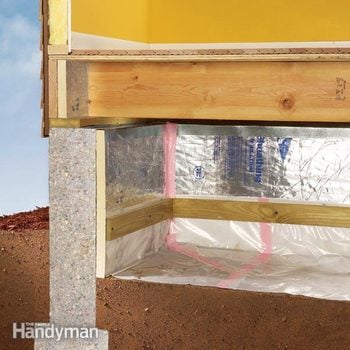
The best solution is to completely close up the vents (or omit them in new construction) and control crawlspace moisture in other ways. The photo illustrates several key concepts. However, local and regional conditions vary and the exact details of this system may not work in every crawlspace. Make sure to get approval from your local building inspector before taking any steps.

  1. Create good drainage around your home to keep rainwater from flowing in under your house. Sloping the soil away from your home at about 1/2 in. per foot is usually the best thing you can do to reduce crawlspace moisture.
  2. Cover the dirt crawlspace with a plastic moisture barrier. Overlap any seams and tape them. And bring the plastic about 6 in. up the wall and fasten it there. Stake the plastic down with landscape fabric stakes to keep it in place. Chances are that someone will have to slide around in the crawlspace later to fix a pipe or run a new cable. A few holes won't make any difference in performance, and they'll drain puddles if a heavy rain or leaky pipe leaves water on the plastic.
  3. Cover exposed foundation walls with 1-1/2 in. of rigid, moisture-proof insulation. This not only insulates the walls but also keeps rising dampness in the concrete from getting into the crawlspace. We used Thermax brand (available through lumberyards) because it doesn't require an additional fire barrier. Other types may require a drywall covering.
  4. Insulate the rim joists. We used rigid insulation and caulked it in place to stop air leaks.
  5. Cap the interior of the foundation wall with a 6-mil layer of plastic and galvanized flashing both to block moisture and to serve as a termite barrier. There is no sure solution for termites; building codes may require different details for termite control in your region.

Back to Top

Required Tools for this Project

Have the necessary tools for this DIY project lined up before you start—you’ll save time and frustration.

    • Hammer
    • Tape measure
    • Caulk gun
    • Straightedge
    • Utility knife

Required Materials for this Project

Avoid last-minute shopping trips by having all your materials ready ahead of time. Here's a list.

    • Rigid insulation
    • Treated 1x4s
    • Caulk
    • 1-1/2 in. rigid insulation
    • 6-mil plastic
    • Tape
    • Landscape fabric stakes

Comments from DIY Community Members

Share what's on your mind and see what other DIYers are thinking about.

1 - 7 of 7 comments
Show per page: 20   All

April 13, 10:37 PM [GMT -5]

I am working on this project now. I bought the 6 mil plastic, but I hear of 20 mil plastic which isn't at the local hardware store. Dealing with the 6 mil plastic is rough. It is 20 feet wide and costs $ 98 for 100 feet. That will cover the crawl space. I have so much work just to get to how I adhere the plastic up the wall on cement blocks. I insulated the floors; that part is complete. I have the wires and flex pipes for HVAC taken care of. I have removed the 50-year old plastic which also was 6 mil best I can tell. I have removed the debris from the basement. Each sentence here on this post is a day's work by itself. This is an unreal amount of work. I had to stop and go to hardware store to buy goggles that wrap my eyes because all the goggles I have I used outside with the weed-eater and tools like that and I cannot see under there. I have installed light fixtures throughout the crawl space. I still need a flashlight with me during the bright sunny days under there. I am just whining. Need to vent.

Your 1st step is excellent. I have done that, but you telling me I should have done that, is a reinforcement you are starting off on the right track.

2nd Step. How am I supposed to fasten the 6 mil paper to concrete blocks ? Why 6 " up " I think how far up depends on how high the vents are. Vents are most important. I cannot imagine the cost of having a self-contained system for the 60-years this crawl space has existed to-date. And, what happens with such a system when it fails in the 60 years ? Landscape fabric stakes to hold it down is a great concept too. I have no idea what it is, where I get it, what I am asking for, and why I would want to purposely punch holes in a $ 100 sheet of plastic I have already purchased and starting working with now. Great Scott is it rough dealing with 20' x 100'. You cut off 10 feet off the roll and you have 10' x 20'. I have to deal with the support columns in the middle of the home. I see folks go up the support columns with the 6 mil plastic. I have no concept of how they do that when you look at their completed task. I see this as a 3 month project since I have a day-job obviously and have the do this Saturday and Sunday mornings only. In fact, it is Spring now and I have mowing, weeding, grass seeding, planting, trench composting, hedge trimming, car washing, Spring home cleaning, painting, and oh by the way, that assumes there is nothing that goes wrong requiring me to work on that too. Projects such as this one require as much thought ahead of time, as can be contemplated. I do not wish to re-do this work again in the next 60 years. So, what I am doing now is for the next guy, since I will not outlive this project's lifetime. The workers in the last 50 years have totally destroyed the vapor barrier. It's useless now.

Mine is dirt. I wonder if folks aren't giving advice for cement crawl spaces ?

Should I stop and put some cement on the top of the dirt first ? That would be very hard to crawl on the next 50 years, no matter how smooth I can make it down there now.

My crawl space is like 2 feet dirt to top. I have no room to work. Pictures I see are 4 feet crawl spaces. I would die to have even a 3 feet crawl space.

Should I stop and dig it out to 4 feet ?

I'd love to do that too.

Cover exposed foundation walls with 1-1/2 in. of rigid, moisture-proof insulation. How do I do that ? What is that ?

I do not know what a rim joist is or rigid insulation, either.

Termite barrier ? This is the 1st I've heard of that. I had termite actual treatment again since the home is 60 years old. I've done that now 3 times. I have thought about spraying for bugs down there while I am there, not sure before or after I put the plastic in ?

Great article. I could spend as much time addressing my questions from it, as it allows me to do the whole job.

1 Day.

Not if it was a 5 feet by 5 feet space, could I accomplish the tasks.

I think I am in a half the home's width concept right now. I've got the materials. I have no idea where to start. None. But, I don't have thousands to pay a company to come do a half-way job and leave me with decisions I'd like to make myself.

February 02, 9:48 PM [GMT -5]

We had moisture problems in the summer. I took digital pictures & one showed water streaming off a vent. We have now sealed up all the vents (as recommended), replaced our older unit, replaced all the ductwork (they now have an open vent or two in the crawlspace), wore protective masks & etc and scrubbed off mold with tea tree oil & reapplied the tea tree oil as
a preventive for further mold & have had a vapor barrier installed on the foundation floor which was overlapped & sealed with Mastic. After research, we decided to seal the brick & masonary foundation walls with Radon Seal (masonary) and LastiSeal (brick) & hope we won't need further insulation on the walls. We figured if it prevented water from coming in basement walls it should prevent moisture from coming from the masonary & bricks. Hope this helps.

July 03, 11:03 AM [GMT -5]

not yet done. very helpful

March 27, 8:19 PM [GMT -5]

Working on insulation at the moment, then come back with vapor barrier. My crawlspace has a sump pump, and moisture runs by block foundation to sump pump, so not sure system will work for me. Thinking of using 1 x 4s attached below vents, and keeping the space vented.

Any suggestions on screws to use to hold the vapor barrier and 1 by 4s?

February 14, 12:53 PM [GMT -5]

For the most thorough website to answer all your questions pertaining to crawlspaces visit http://crawlspaceinfo.com This is the most helpful site that i have found.

August 03, 4:18 PM [GMT -5]

I understand that the ISO boards are great in R per inch, (what is shown against the concrete) but that they can wick up water. For that reason would extruded polystyrene be a better choice?

June 18, 9:47 PM [GMT -5]

My contractor says that the ground level under the crawl space should be ABOVE the outside ground level. Is this correct? The photo clearly shows the the crawl space ground level is BELOW the outside ground level.

+ Add Your Comment
closeX

Add Your Comment

How to Install a Vapor Barrier in a Crawlspace

Did you complete this project?

  • Yes
  • No
Please add your comment
closeX

Log in to My Account

Log in to enjoy membership benefits from The Family Handyman.

  • Forgot your password?
Don’t have an account yet?

Sign up today for FREE and become part of The Family Handyman community of DIYers.

Member benefits:

  • Get a FREE Traditional Bookcase Project Plan
  • Sign up for FREE DIY newsletters
  • Save projects to your project binder
  • Ask and answer questions in our DIY Forums
  • Share comments on DIY Projects and more!
Join Us Today
closeX

Report Abuse

Subject
Reasons for reporting post
Save and organize projects in your Project Binder with a FREE Membership! Join today»

Free OnSite Newsletter

Get timely DIY projects for your home and yard, plus a dream project for your wish list!