Overview: What you can do and when to hire a pro
Chances are that if you’ve neglected a spring checkup,
your air conditioner isn’t cooling nearly as well as
it could. A year’s worth of dirt and debris clogging
the cooling fins, a low coolant level, a dirty blower fan filter and
a number of other simple problems can significantly reduce the
efficiency of your air conditioner and wear it out faster.
You can’t do everything; only a pro can check the coolant
level. But you can easily handle most of the routine cleaning
chores and save the extra $120 that it would cost to have a pro
do them.
In this article, we’ll show you how to clean the outdoor
unit (called the condenser) and the accessible parts of the
indoor unit (called the evaporator). All the steps are simple
and straightforward and will take you only a few hours total.
You don’t need any special skills, tools or experience. If you
aren’t familiar with air conditioners and furnaces/blowers,
don’t worry. We’ll walk you through the basics. See “Parts of
a Central Air Conditioner,” below, to become familiar with how
an air conditioner works and the parts of the system.
You may have a different type of central air conditioner than we show here—a heat pump system, for example, or a unit
mounted horizontally in the attic. However, you can still carry
out most maintenance procedures we show here, because
each system will have a condenser outside and an evaporator
inside. Use the owner’s manual for your particular model to
help navigate around any differences from the one we show in
our photos. And call in a pro every two or three years to check
electrical parts and the coolant level.
Tip: Call for service before the first heat wave, when the
pros become swamped with repair calls!
Typical central air conditioner system
Figure A: Parts of a central air conditioner
The outside unit, called the condenser, contains a
compressor, cooling fins and tubes and a fan. The
fan sucks air through the fins and cools a special
coolant, which the compressor then pumps into the
house to the evaporator through a copper tube.
The coolant chills the fins and tubes of the evaporator.
Warm air drawn from the house by the blower
passes through the evaporator and is cooled and
blown through ducts to the rooms in the house. The
evaporator dehumidifies the air as it cools it, and the
resulting condensation drains off to a floor drain
through a tube. The blower unit and ducting system
vary considerably depending on whether you have a
furnace (shown), a heat pump or some other
arrangement. It may be located in the basement,
garage, furnace room or attic.
Step 1: Clean the condenser
1 of 5
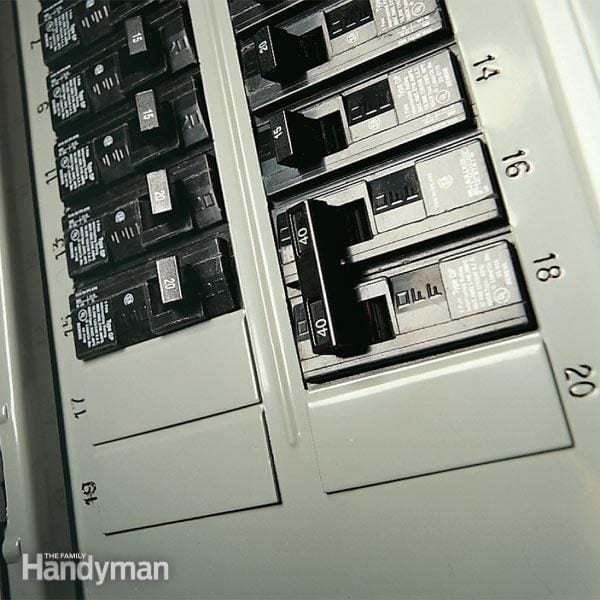
Photo 1: Turn off the power
Turn off the electrical power to the condenser unit at
the outdoor shutoff. Either pull out a block or move a
switch to the off position. If uncertain, turn off the
power to the AC at the main electrical panel.
2 of 5
Photo 2: Vacuum away debris
Vacuum grass clippings, leaves and other debris from
the exterior fins with a soft brush attachment. Clear
away all bushes, weeds and grass within 2 ft. of the
condenser.
3 of 5
Photo 3: Straighten fins
Realign bent or crushed fins with gentle pressure
from a dinner knife. Don't insert the knife more than
1/2 in.
4 of 5
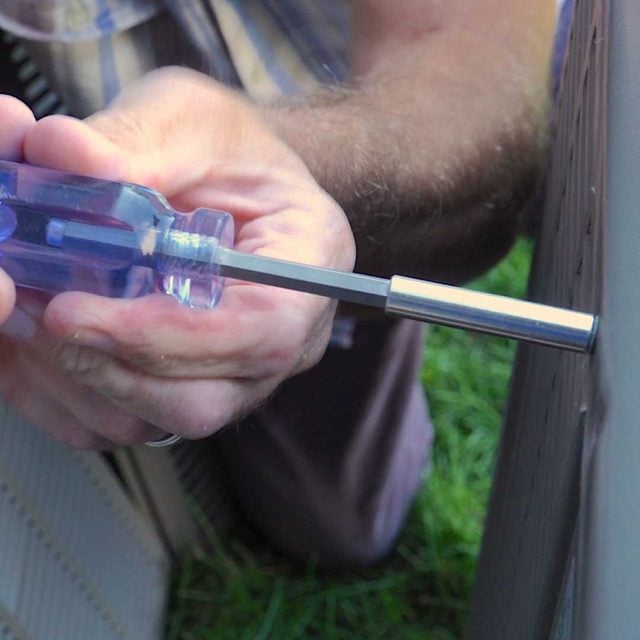
Photo 4: Remove the fan
Unscrew the top grille. Lift out the fan and carefully
set it aside without stressing the electrical wires. Pull
out any leaves and wipe the interior surfaces clean with
a damp cloth.
5 of 5
Photo 5: Clean the fins
Spray the fins using moderate water pressure from a
hose nozzle. Direct the spray from the inside out.
Reinstall the fan.
Clean your outdoor unit on a day that’s at least 60 degrees F.
That’s about the minimum temperature at which you can
test your air conditioner to make sure it’s working. The condenser
usually sits in an inconspicuous spot next to your
house. You’ll see two copper tubes running to it, one bare
and the other encased in a foam sleeve. If you have a heat
pump, both tubes will be covered by foam sleeves.
Your primary job here is to clean the condenser fins,
which are fine metallic blades that surround the unit. They
get dirty because a central fan sucks air through them,
pulling in dust, dead leaves, dead grass and the worst culprit—
floating “cotton” from cottonwood trees and dandelions. The debris blocks the airflow and reduces the unit’s
cooling ability.
Always begin by shutting off the electrical power to the
unit. Normally you’ll find a shutoff nearby. It may be a switch
in a box, a pull lever or a fuse block that you pull out (Photo
1). Look for the “on-off” markings.
Vacuum the fins clean with a soft brush (Photo 2); they’re
fragile and easily bent or crushed. On many units you’ll have
to unscrew and lift off a metal box to get at them. Check your
owner’s manual for directions and lift off the box carefully to
avoid bumping the fins. Occasionally you’ll find fins that have
been bent. You can buy a special set of fin combs (from an
appliance parts store) to straighten them. Minor straightening
can be done with a blunt dinner knife (Photo 3). If large
areas of fins are crushed, have a pro straighten them during a
routine service call.
Then unscrew the fan to gain access to the interior of the
condenser. You can’t completely remove it because its wiring
is connected to the unit. Depending on how much play the
wires give you, you might need a helper to hold it while you
vacuum debris from the inside. (Sometimes mice like to over-winter
there!)
After you hose off the fins (Photo 5), check the fan motor
for lubrication ports. Most newer motors have sealed bearings
(ours did) and can’t be lubricated. Check your owner’s manual
to be sure. If you find ports, add five drops of electric
motor oil (from hardware stores or appliance parts stores).
Don’t use penetrating oil or all-purpose oil. They’re not
designed for long-term lubrication and can actually harm the
bearings.
If you have an old air conditioner, you might have a belt-driven
compressor in the bottom of the unit. Look for lubrication
ports on this as well. The compressors on newer air conditioners
are completely enclosed and won’t need lubrication.
Step 2: Restart the condenser (outside unit)
1 of 1
Photo 6: Confirm proper cooling
Turn the power back on, then set the house thermostat
to "cool" so the compressor comes on. After 10
minutes, feel the insulated tube. It should feel cool. The
uninsulated tube should feel warm.
In most cases, you can simply restore power to the outside
unit and move inside to finish the maintenance. However, the
compressors are surprisingly fragile and some require special
start-up procedures under two conditions. (Others have
built-in electronic controls that handle the start-up, but
unless you know that yours has these controls, follow these
procedures.)
1. If the power to your unit has been off for more than four
hours:
- Move the switch from “cool” to “off” at your inside thermostat.
- Turn the power back on and let the unit sit for 24 hours.
(The compressor has a heating element that warms the
internal lubricant.)
- Switch the thermostat back to “cool.”
2. If you switched the unit off while the compressor was
running:
- Wait at least five minutes before switching it back on.
(The compressor needs to decompress before restarting.)
With the air conditioner running, make sure it’s actually
working by touching the coolant tubes (Photo 6). This is a
crude test. Only a pro with proper instruments can tell if the
coolant is at the level for peak efficiency. But keep a sharp eye
out for dark drip marks on the bottom of the case and beneath
the tube joints. This indicates an oil leak and a potential coolant
leak as well. Call in a pro if you spot this problem. Don’t tighten
a joint to try to stop a leak yourself. Overtightening can make
the problem worse.
Step 3: Clean the indoor unit
1 of 4
Photo 7: Check the furnace filter
Turn off the power to the furnace at a nearby switch
or at the main panel. Then pull out the furnace filter
and check it for dirt buildup. Change it if necessary.
2 of 4
Photo 8: Vacuum and lubricate
Open the blower compartment and vacuum up the
dust. Check the motor for lubrication ports. If it has
them, squeeze five drops of electric motor oil into each.
3 of 4
Photo 9: Clean the drain tube
Pull off the plastic condensation drain tube and check
it for algae growth. Clean it by pouring a bleach/
water solution (1:16 ratio) through the tube to flush the
line. Or simply replace the tube.
4 of 4
Photo 10: Clean the drain port
Poke a pipe cleaner into the drain port and clean out
any debris. Reinstall the drain tube and turn the
power back on.
The evaporator usually sits in an inaccessible spot inside a
metal duct downstream from the blower (Figure A). If you
can get to it, gently vacuum its fins (from the blower side)
with a soft brush as you did with the condenser.
However, the best way to keep it clean is to keep the airstream
from the blower clean. This means annually vacuuming
out the blower compartment and changing the filter
whenever it’s dirty (Photos 7 and 8).
Begin by turning off the power to the furnace or blower.
Usually you’ll find a simple toggle switch nearby in a metal
box (Photo 7); otherwise turn the power off at the main
panel. If you have trouble opening the blower unit or finding
the filter, check your owner’s manual for help. The manual
will also list the filter type, but if it’s your first time, take the
old one with you when buying a new one to make sure you
get the right size. Be sure to keep the power to the blower off
whenever you remove the filter. Otherwise you’ll blow dust
into the evaporator fins.
The manual will also tell you where to find the oil ports on
the blower, if it has any. The blower compartments on newer
furnaces and heat pumps are so tight that you often can’t
lubricate the blower without removing it. If that’s the case,
have a pro do it during a routine maintenance checkup.
The evaporator fins dehumidify the air as they cool it, so
you’ll find a tube to drain the condensation. The water collects
in a pan and drains out the side (Figure A). Most tubes are flexible
plastic and are easy to pull off and clean (Photos 9 and
10). But if they’re rigid plastic, you’ll probably have to unscrew
or cut off with a saw to check. Reglue rigid tubes using a coupling,
or replace them with flexible plastic tubes.
Back to Top