How to Install Fiber Cement Siding
Updated: Mar. 28, 2023How to cut, nail and install durable fiber siding, plus caulking and painting tips.
- Time
- Complexity
- Cost
- Multiple Days
- Intermediate
- $501-1000






Fiber cement is tougher than other materials
When you want the classic look of wood siding coupled with lifetime durability, fiberboard cement siding may well be your best choice. Fiberglass cement siding is a composite made of Portland cement, silica and wood fiber. Once painted, it looks almost identical to wood. It’s available in many styles and widths, both smooth and wood textured, and you still get the crisp joints and details that’ll make your home’s exterior stand out. In addition, it’s highly rot and insect resistant, won’t burn and paints beautifully.
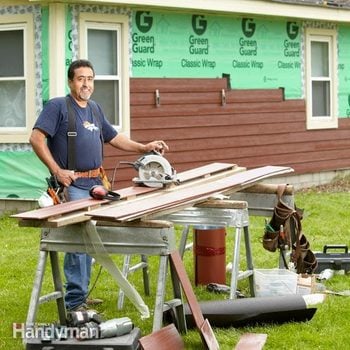
Jaime Venzor has been in the siding business for more than 15 years. He started out installing mostly vinyl, but now 80 percent of his work is fiber cement. He earned his good reputation with his customers by doing things the right way, and he earned our thanks by sharing some of his knowledge with us. So read on and learn what Jaime thinks are the most important tips.
Hold the starter 1/4 in. down
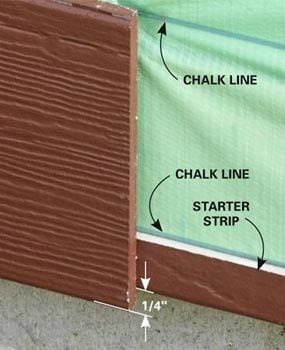
Create a drip edge
Find your most beat-up pieces of siding and rip them down into 1-1/4-in. starter strips. These strips, installed at the bottom, will make your first row of siding angle out to match the rest of the rows. Snap a line 1 in. above the bottom of the wall sheathing as a guide. Install these fragile starter strips with a 15-gauge trim gun. Snap another line for the bottom row of siding, positioning it so it will hang down an additional 1/4 in. from the starter.
Nailing Basics
Fiberboard cement siding can be hand-nailed, but because it’s so much harder and more brittle than wood, you have to predrill holes near any edge. You can save yourself a bunch of time by using a pneumatic coil siding nail gun. Unfortunately, a siding gun will set you back twice as much as a 15-gauge trim gun, and it’s only half as versatile, so if installing fiber cement isn’t your full-time gig, you may want to rent one (about $110 a week). Every manufacturer has specific nailing guidelines, but here are some basic rules:
- Use 6d or 8d galvanized or stainless siding nails and install a single nail about 1-in. down from the top edge at each stud, no more than 16 in. apart. n Nail lengths should be chosen so they penetrate a minimum of 1-1/4 in. into the solid wood (wood sheathings like OSB and plywood count toward the 1-1/4 in., but “soft” sheathings like fiber board and foam don’t).
- Don’t drive nails into the siding at an angle.
- Fastener heads should be snugged up against the siding, not driven into the surface.
- The end of each plank making up a butt joint needs to be fastened to a stud.
- Nail butt joints last. That way you can tweak the ends of each plank so the bottom edges line up perfectly.
Preassemble the corners
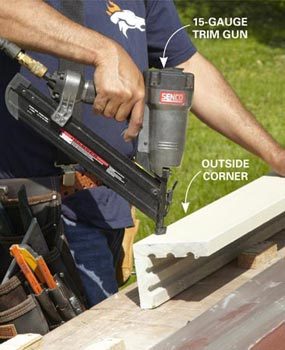
Use a finish nailer for trim
It’s a lot easier to preassemble corners on a flat surface. Jaime uses 2-1/4-in. galvanized nails in his 15-gauge trim gun. He uses the same size nails to install the corners on the wall. Don’t use a framing gun or try to handnail the corners together; that’s a good way to break the trim boards. Also, the trim nails look better where nails will be exposed, especially on a prefinished corner board. So, if you don’t have a 15-gauge trim gun, what a perfect “opportunity” to go buy one.
Install fiber cement using a few special techniques
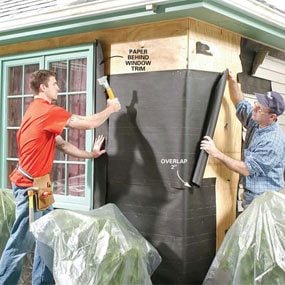
Photo 1: Staple building paper to the sheathing
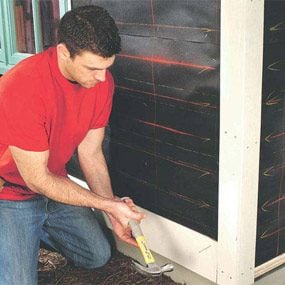
Mark stud locations at the top and bottom of the wall. Staple building paper to the wall sheathing, lapping top pieces over bottom pieces by at least 2 in. Fit and slide paper behind the window trim.
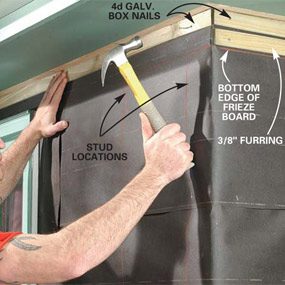
Photo 2: Nail furring strips at the top of the wall
Snap chalk lines to mark the frieze board location and nail treated furring strips along the lines. Keep the bottom strip 1/4 in. above the bottom line.

Photo 3: Use a circular saw to cut the frieze board
Cut the frieze board to length with a circular saw, using a rafter angle square as a cutting guide. True up cut ends with a rasp or a sanding block.
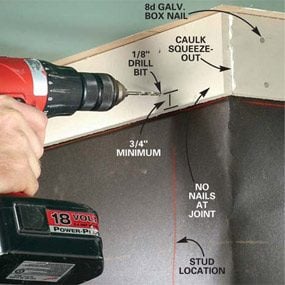
Photo 4: Predrill holes for easy installation
Predrill and nail the frieze boards, driving two galvanized box nails into each stud. Hold the nails at least 3/4 in. from the edges. Drive the nailheads snug with the surface of the siding. Do not overdrive them. Apply caulk at the corner lap joint before installing the second piece.
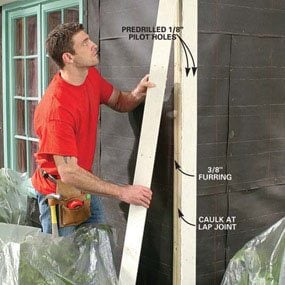
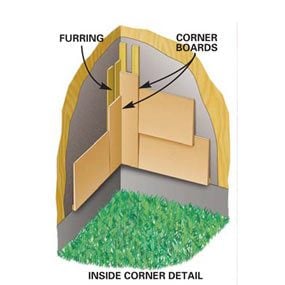
The layout process is exactly the same as for wood siding. Mark the stud locations with a pencil on the soffit and foundation where they won’t be covered by the building paper. Install the building paper (Photo 1), then follow your stud location marks and snap chalk lines (Photo 2) to guide both your nailing and your placement of siding joints. We’re also using fiber cement trim boards. Since they’re only 7/16 in. thick, rip 3/8-in. thick strips from treated 2-by lumber and use them to fur out the frieze boards (Photo 2). Now they’ll sit about 1/8 in. above the lap siding.
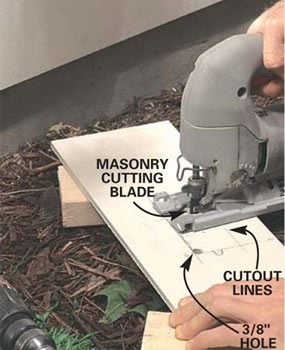
Cut the frieze board to length (Photo 3). Fiberboard cement siding is highly abrasive. Even a carbide tooth blade will last for only part of the day. At home centers, you can buy diamond blades made specifically for cutting fiber cement. These blades cut quickly and create less dust. But we had success with a less expensive dry-cut, diamond masonry blade. Drill cutouts for electrical boxes and pipes with regular twist bits or spade bits, and make interior or even curved cuts with a jigsaw fitted with a tungsten or carbide grit blade (these blades are available at home centers and tile stores). Cutting fiberglass cement siding raises a lot of silica dust, so work outside and wear a dust mask.
Nail up the frieze board by drilling 1/8-in. pilot holes and driving two galvanized box nails at each stud (Photo 4). Your nail length may vary from ours depending on the type of exterior sheathing used on your home. In general, use nails that penetrate the studs at least 1 in. Drive the nailheads snug against the fiber cement board. If driven too deep, the heads will crush the fiber cement board and reduce the nail’s holding power. Don’t nail fiber cement corners together (Photo 4). A nail driven into the edge of a fiber cement board will split it.
Next make the outside corner (Photo 5), following the same steps as for the frieze boards. Be sure the bottoms of the corner boards cover about 1/2 in. of the foundation.
Tip:
If you don’t have access to a table saw, buy a sheet of 1/2-in.treated plywood and rip furring strips with a circular saw.
Caution!
Cut outdoors, wear a dust mask to avoid breathing the dust, and keep others away.
Layout the siding courses
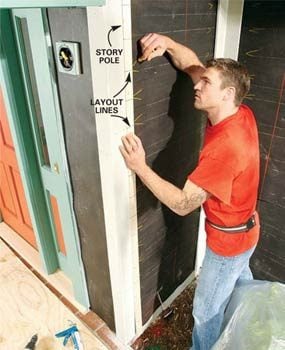
Photo 6: Mark the siding course locations
Mark the top of each siding course using the story pole as a guide (see “Making a Story Pole.”). Then snap chalk lines to keep each course straight.
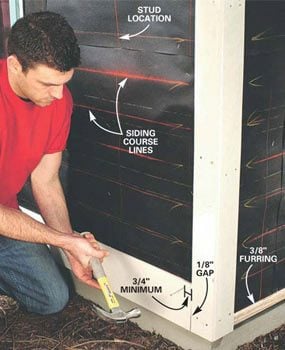
Photo 7: Install the first course of siding
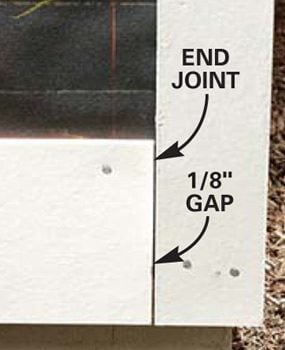
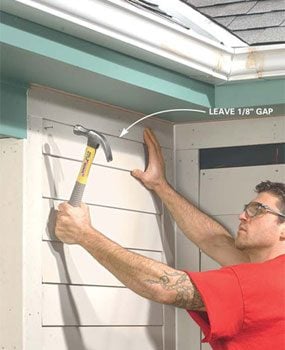
Nail a 3/8-in. treated starter strip along the bottom of the wall. Then cut and nail the first course of siding along the layout line. Leave a 1/8-in. gap at the end, and nail at each stud with a single 8d galvanized box nail held 1 in. down from the top edge.
With the trim boards completed, lay out the siding courses with a story pole. (See “Making a Story Pole.”) Hold the top of the story pole snug against the frieze board and mark out the siding courses (Photo 6) at all corners and around windows and doors. Following these layout marks, snap horizontal chalk lines. Remember that these layout lines represent the top of each siding course.
Rip and nail up a 3/8-in. thick treated wood starter strip along the bottom of the wall (above the foundation). This strip will tip the first piece of siding to the proper angle. Measure and cut to length the first piece of siding and nail it in place (Photo 7).
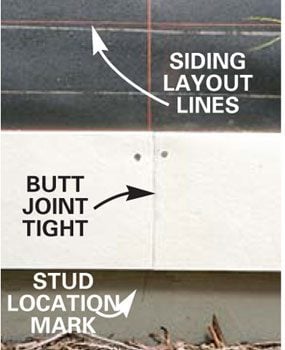
Leave a 1/8-in. gap where the end meets the corner board (Photo 7, inset) and make sure the other end lands on a stud line. Install the next piece so its end butts lightly against the first (Photo 7, inset). Continue with the siding courses, aligning the top edges to the layout chalk lines. Be sure to stagger the butt joints so they don’t lie on top of each other as you work your way up.
Tip:
Pros use pneumatic coil nailers (you can rent one) designed specifically for fiberboard cement siding. They cut nailing time in half. If you go this route, practice first to make sure the nailheads will be set flush.
Making a Story Pole
Cut a straight 1×2 so its length runs from the frieze board to the bottom of the first siding course. Measure up from the bottom of the story pole to mark the full width of the first course of siding. Remember, this mark represents the top of the siding piece, not the bottom of the second course.
From this point, make marks up the pole at the recommended exposure for your siding. The top course should be at least two-thirds the width of the lower courses. Check your layout marks against window and door openings and other features around the house, and adjust the exposure to avoid having to rip narrow pieces.
When the final layout is OK, draw heavy lines on the face and both edges of the story pole using a square. Now hold the story pole tight against the frieze board at all corners and alongside windows and doors. Transfer the layout marks to the wall and snap chalk lines. This will ensure that all the siding courses go on straight and uniformly.
Remove the plastic last
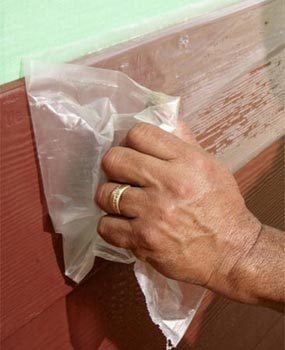
Protect prefinished fiber cement board
Prefinished fiberglass cement siding boards come with a protective plastic coating. To protect the paint from getting scratched during installation, leave the plastic on and make your cuts right through it. Peel away the plastic after the board has been fastened to the wall.
Flash the butt joints
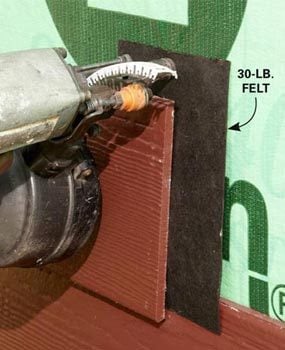
Keep water out
Caulking butt joints is unnecessary, and some manufacturers prohibit it. However, you should flash behind the joints. You can use metal, house wrap or any other approved WRB (weather-resistant barrier), but Jaime prefers to use 30-lb. felt paper. It’s easy to work with and cheap, and it isn’t noticeable if a seam happens to open up a little. Tack it to the wall so it doesn’t get knocked out of place when you install the second piece of siding.
Spacing for Fiber Cement Board Joints
Fiber cement boards don’t expand and contract much, but leave a little room for expansion at the end joints and then fill the gap with caulk. Butt joints, however, should be nailed tightly together and should not be caulked. Make sure all butt joints are on studs, and stagger the butt joints as you work your way up the wall.
Windows need drip cap and a gap on top
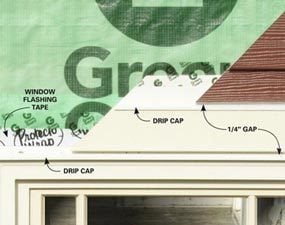
Window and door detail
Whether or not you’re installing trim boards around your windows, you’ll need to install a drip cap over the window. You’ll also need to leave a 1/4-in. gap (no caulking) between the top of the window and the plank or trim board directly above it. This is to allow any water that may have gotten behind the siding to weep out. Tape the drip cap to the wall, but don’t tape all the way to the bottom of the drip cap because it will be visible through the 1/4-in. gap. The top trim board will also need its own drip cap and 1/4-in. gap. Treat the tops of doors the same way.
It’s a two-man job without siding gauges
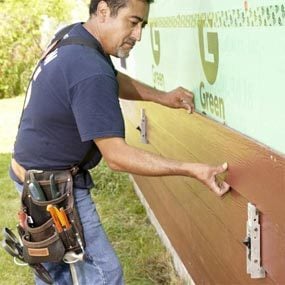
Siding gauges hold boards
Fiberboard cement siding is heavy and breaks if it’s bent too much. Installing this stuff by yourself is tough, but it’s possible with the aid of siding gauges. These tools not only create the proper reveal (the part of the siding that shows) between rows but also actually hold the planks in place while you nail. Even if you do just one fiber cement job, siding gauges are worth the money.
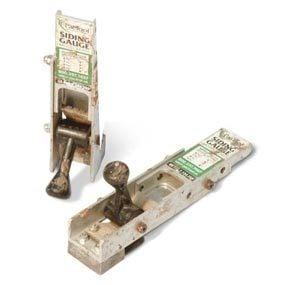
Gecko siding gauges
A pair of the SA902 Gecko Gauges shown here costs about $90 (available though our affiliation with amazon.com), but cheaper versions are available. Most gauges are adjustable to accommodate reveals from 5 to 8 in.
Painted vs. Primed
We decided to use a prefinished product in this story, but the other way to go is simple primed siding. That material is primed and ready for you to paint. Here are some facts to consider when making your decision.
The advantages of primed: Primed products cost 50 percent less than prefinished products. On-site painting looks better up close because the touch-up paint and caulked areas aren’t as noticeable. Primed products are easier and less expensive to install.
The advantages of prefinished: The color on a prefinished product won’t fade nearly as fast. Some finishes come with a 15-year warranty. But the best part of using a prefinished product is that after installation, you’re done and not faced with painting an entire house.
Cut fiber cement boards with a circular saw
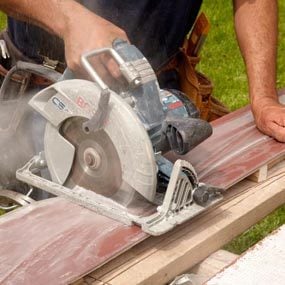

Tons of fiber cement cutting gadgets are available, but most jobs can be handled with just a steady eye and a standard circular saw fitted with a fiber cement blade. If you plan to hang a lot of fiber cement, though, you’ll want a chop saw with a proper blade that will allow you to cut several pieces at once.
Vinyl mounting blocks work best
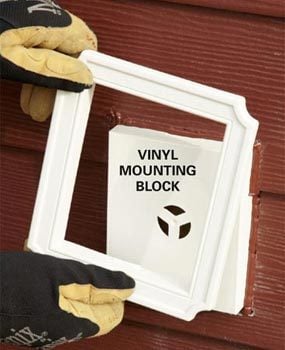
Lights, receptacles and vents
Most fiber cement manufacturers make mounting blocks for lights, electrical receptacles, A/C lines, PVC venting, etc. Jaime prefers to use the vinyl mounting blocks typically used with vinyl siding. They’re cheaper and easy to install, and you can cut the proper-size hole in a plastic mounting block with a utility knife or a snips. With fiber cement blocks, you have to use a jigsaw or a hole saw.
MountMaster is one brand of blocks sold at Lowe’s and many lumberyards. It’s available in more than 25 colors, but you can order paintable blocks if you want an exact match with your siding or trim.
Paint, prime or caulk all cut edges
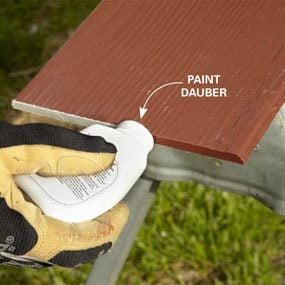
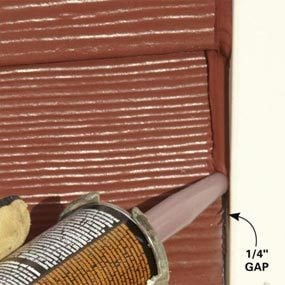
Every time you cut a plank, you create an exposed surface that has no primer or paint to protect it from the elements. If a cut edge is going to butt up against a corner post or trim board, it gets caulked. If the cut edge is part of a butt joint in the middle of the wall, it needs to be painted (try to use factory edges on all butt joints). Planks that have been cut to fit over windows and doors also need paint. Order paint kits and caulking to match both the trim and the siding colors. Your siding supplier should have access to both.
The Lowdown on Clearances
Fiberboard cement siding is not bulletproof—it will deteriorate if exposed to water for a long time. It’s imperative that you honor the proper spacing between the siding and the roof surfaces and between the siding and the horizontal surfaces, such as the ground or cement slabs and decks. Check with your specific manufacturer before you start. Here are some general guidelines.
Leave:
- 1/8 in. to 1/4 in. between siding and trim
- 1/4 in. between siding and horizontal flashing
- 1 in. between the gutter and an adjacent wall
- 2 in. between siding and roofing, decks, patios, driveways, steps and walkways (using PVC trim boards is a good way to accomplish these clearances)
- 6 in. between the siding and the ground.
Don’t skip the kick-out flashing
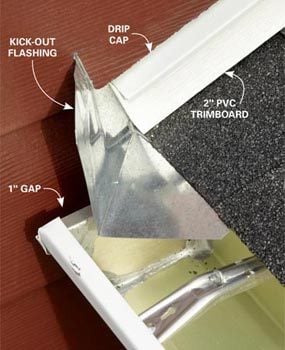
Kick-out flashing
Kick-out flashing is essential for preventing water from running down a roof and behind the siding on an adjacent wall. You’ll fail your inspection if the inspector doesn’t see it on your job. It’s a pain to work around, but it helps if you don’t nail the flashing tight until you have your siding cut to size. It’s much easier to get a proper fit for a plank if you can shift the flashing beneath it.
Cutting fiber cement board around openings
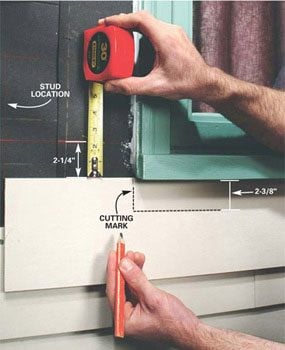
Mark the siding to fit around windows
Hold the siding snug under the windowsill and mark the window edge location. Then measure from the chalk line to the top of the siding. Add 1/8 in. to your measurement. This is the width of the cutout.
Notch to go around windows and doors. Be sure to allow a 1/8-in. gap where the siding meets the window trim and sill. This joint will be caulked later. Nail the top edge of the siding along the windowsill at each stud. These nailheads will be exposed, but the paint will cover them.
Notch to go around windows
Photo 8: Mark the siding to fit under windows
Hold the siding snug under the windowsill and mark the window edge location. Then measure from the chalk line to the top of the siding. Add 1/8 in. to your measurement. This is the width of the cutout.
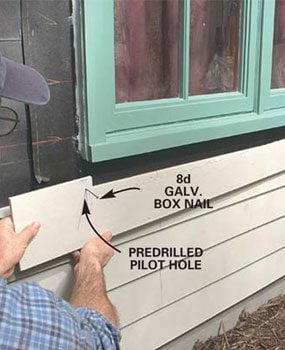
Photo 9: Install the notched siding under the window
Cut out the notch with your saw and slide the piece into place, leaving a 1/8-in. gap between the siding and windowsill. Caulk this gap later. Predrill and nail at each stud, including under the window.
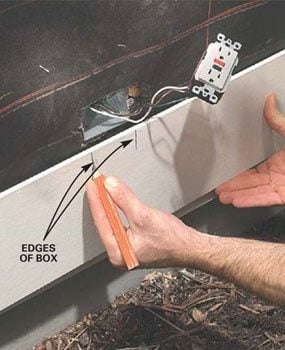
Photo 10: Mark cutouts in the siding
Hold siding in place under wall penetrations such as this electrical box. Mark the width and height of the cutout. Caution: Turn off the power to the receptacle before removing it from the box.
Notch to go around windows and doors (Photos 8 and 9). Be sure to allow a 1/8-in. gap where the siding meets the window trim and sill. This joint will be caulked later. Nail the top edge of the siding along the windowsill at each stud. These nailheads will be exposed, but the paint will cover them.
Water intrusion around wall penetrations can be a problem for any type of siding. Lay out and make the cutout for the electrical box (Photos 10 and 11). The electrical box cover is gasketed to seal out water. For pipes, electrical entries and similar fixtures, fit the siding as tightly as possible and then seal with a polyurethane caulk or non-hardening electrician’s putty. Rip the top course of siding to width and nail it up (Photo 12). Hold these nails 1 in. below the top edge. Again, these nailheads will be exposed.
Buy the siding already primed. If you prime it yourself, use an alkali resistant primer. Caulk all the joints with an acrylic latex caulk before applying the final coats of paint. Be sure the caulk fills the 1/8-in. joint completely to keep it watertight. Finish-coat with a 100 percent acrylic latex paint.
Tip:
If you live in a region of high rainfall or the wall is highly exposed to water, slip a 3-in. wide strip of building paper behind butt joints. Be sure the bottom edge of the paper laps on top of the lower course of siding.
Required Tools for this Project
Have the necessary tools for this DIY project lined up before you start—you’ll save time and frustration.
- Air compressor
- Air hose
- Caulk gun
- Chalk line
- Circular saw
- Cordless drill
- Drill bit set
- Dust mask
- Hammer
- Jigsaw
- Level
- Safety glasses
- Sawhorses
- Speed square
- Stapler
- Tape measure
Required Materials for this Project
Avoid last-minute shopping trips by having all your materials ready ahead of time. Here’s a list.
- 15 gauge stainless steel or galvanized finish nails
- 30 lb. felt
- 6d galvanized nails
- Acrylic caulk
- Drip cap
- Fiber cement siding
- Kick-out flashing
- Paint
- Vinyl mounting blocks