

Home Air Cooling Tips
Updated: Feb. 07, 2024
Six strategies for keeping your home cool







Introduction
Window air conditioners or central air aren't the only way to cool down a hot house. Check out these alternative solutions for making your house more comfortable.Project step-by-step (6)
How to Remove Hot Air from a Room: Cool down with a whole-house fan
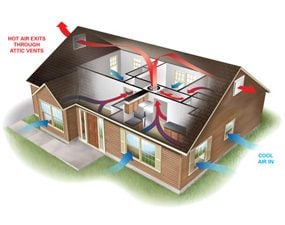
Whole-house fan
A whole-house fan uses one-tenth as much power as AC. It draws cooler outside air in through open doors and windows to create a pleasant breeze that pushes hot air out through attic vents.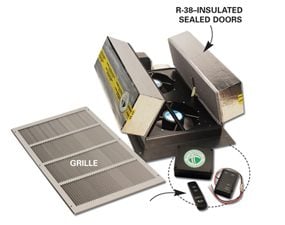
Insulated attic fan door
Newer attic fans have insulated doors that close in 30 seconds when the fan’s not operating.
Whole-house fans may seem old fashioned, but they’re enjoying renewed popularity. The idea behind them is simple. A powerful fan draws cooler early morning and evening air through open doors and windows and forces it up through the attic and out the roof vents. This sends hot air up and out, cooling your house and your attic. These fans are commonly mounted in an upstairs stairwell or hallway ceiling where there’s at least 3 ft. of clearance above the fan.
Main advantages
– Energy savings. They use 90 percent less energy than an air conditioner, and in dry climates with cool mornings and evenings, they can actually replace your AC system.
– Easy installation. With a helper and basic tools, you can install a whole-house fan in a weekend.
Main disadvantages
– They can’t cool inside temps any lower than outside temps and they can’t dehumidify.
– They can make allergies worse. Whole-house fans draw in outdoor pollen and dust.
– Larger fans move air quickly, but they cost more to purchase and install. They also require significant attic ventilation and make more noise than smaller attic fans.
For the best results, match the fan size to your floor plan, cooling needs and available attic ventilation. Call your local utility and check energystar.gov to see which models qualify for local rebates and potential federal tax credits.
How to Remove Hot Air from a Room: Portable air conditioners
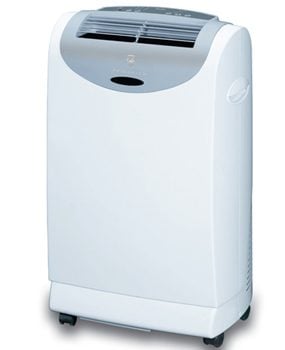
Portable alternative
Portable air conditioners are an alternative to a window unit. They’re easy to operate and to move from room to room. However, they cost more and use more energy. Photo courtesy of Friedrich
Portable air conditioners are similar to window units in operation. They sit on the floor (on casters) and use an adapter kit to vent the hot air through a hose running through a window, a wall or a sliding glass door.
Main advantages
– They are easy to install and use.
– You can move them from room to room.
Main disadvantages
– They’re almost twice as expensive and use more energy than a similar-size window unit with the same cooling capacity.
– At this time there are no Energy Star–qualified portable room air conditioners.
Portables range in price from $300 to $1,500 depending on the size, features and efficiency.

How to Remove Hot Air from a Room: Mini-split system is cool and quiet
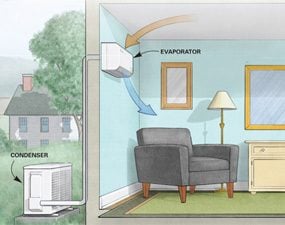
Ductless AC
Mini-split AC systems don’t require ductwork and can be run to one or more rooms. Their small size, quiet operation and individual zoning let you cool only the room you’re using, which can save energy and money.
Long popular in Europe and Japan, a mini-split system air conditioner (sometimes called ductless AC), is a hybrid of central air and a window unit. A small condenser sits outside and connects through a conduit to an inside evaporator mounted high on the wall or ceiling.
Main advantages
– Silent operation. The condenser sits outside, it doesn’t let in street noise and the indoor fan is whisper quiet.
The system can be mounted anywhere thanks to the small size of the indoor and outdoor components. The conduit, which houses the power cable, refrigerant tubing, suction tubing and a condensate drain, runs through a 3-in. hole hidden behind the indoor evaporator.
– Zoning flexibility lets you cool rooms individually.
Main disadvantage
– Cost. Professional installation costs $1,500 to $2,500 including parts and labor. You can install it yourself, but it’s fairly complicated and you’ll most likely void the manufacturer’s warranty. Systems with an efficiency rating of 16 or higher qualify for the federal tax credit in 2010.
How to Remove Hot Air from a Room: In-wall AC unit stays put all year
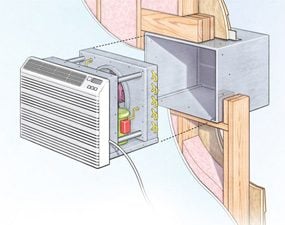
In-wall installation
An in-wall air conditioner means no more wrestling with a window unit every spring and fall. You frame the opening just like you would frame for a window.
An in-wall air conditioner is basically the same as a window unit. The primary difference is that it has vents on the back instead of along the sides and it sits flush or extends only slightly farther out from the exterior wall.
Main advantages
– Permanent installation means you don’t have to lug it in and out twice a year, and it’s not an easy entry point for burglars.
– It doesn’t block a window.
– The chassis unit sits securely inside a metal sleeve that is installed into the wall. The chassis unit slides out for easy servicing.
– The size of the unit isn’t limited to a standard window opening, so it can be bigger and more powerful than a window unit.
Main disadvantages
,p>- Installation is more involved. Cutting a hole in the outside wall of your home may be difficult depending on the exterior sheathing of your home.
– You may need to install a new electrical circuit. Some larger units require 240 volts (although most smaller units can be plugged into a standard 120-volt outlet).
Energy Star-qualified models use 25 percent less energy than models made before late 2000. Check with your utility for energy rebates. Some units provide both cooling and heating. Prices range from $400 for cooling a 400- to 700-sq.-ft. room to $700 or so for cooling/heating a 1,000- sq.-ft. space.
How to Remove Hot Air from a Room: Move the cool air with a ventilator fan
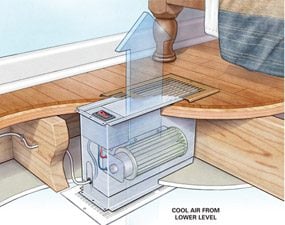
Move air up or down
A ventilator fan can move existing cool air from one level or room to another through the wall or floor.
If you have a hot room in an otherwise comfortable house, you can pump existing cool air into that hot room using a special fan installed in the wall or floor.
Main advantages
– No extra cooling costs. The level-to-level ventilator fan (shown) moves existing cool air from one level (from the basement or a mini-split system, for example) to another level of the house through an adjustable sleeve installed through the floor/ceiling.
– A ventilator fan can blow conditioned air up or down, depending on the position of the blower unit. There are also room-to-room ventilator fans to move the conditioned air. Check out these creative ways to cool a room without AC.
Main disadvantages
– To install the fan, you’ll have to cut a hole through the floor/ceiling and run an electrical line to the unit.
– It’s only practical if you have an abundance of existing cool air that’s easily accessible to your hot room.
Level-to-level ventilator fans (around $200) can also be used to move warm air through the living space during the winter. Search online for “level-to-level fan.”
How to Remove Hot Air from a Room: Increase the flow with a duct or a vent booster fan
img class=”size-medium alignleft” src=”https://images.tmbi.com/wp-content/uploads/wwwroot/tfh/step-by-step/display/fh10jau_hotrom_08.jpg” />
Duct booster
In-line duct and vent booster fans increase the flow of cool air through ducts and registers.
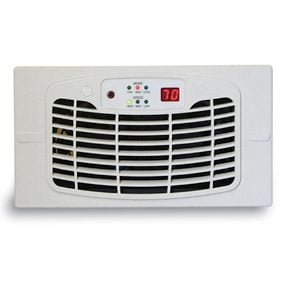
Vent booster
Vent boosters fit over the existing register.
If you have forced-air cooling but there’s still a room that’s hotter than all the rest, a duct or vent booster fan can increase the flow of cool air into that room. Two types of booster fans are available.
An in-line duct booster fan fits inside the duct of the room you’re trying to cool. You mount the fan near the outlet and it automatically kicks on when your cooling system runs.
Vent and register booster fans sit directly on top of or replace ceiling, floor or wall registers. Depending on the model, you can set it to operate automatically, control it with a switch or operate it by a remote control.
Main advantages
– Easy to install and use.
– Reasonably priced. In-line duct booster fans are available in both plug-in and hard-wired models and retail for $30 to $150. Vent and register booster units plug into a nearby electrical outlet or can be hard-wired. Register and vent duct booster fans cost $40 to $100.
Main disadvantages
– Less powerful (and cheaper) in-line units have a lighter-gauge housing that is more prone to rattling.
– Duct or vent booster fans may not make a significant cooling difference if your ductwork or overall cooling system is inefficient, sized improperly or faulty.
Search online for “in-line duct booster fan” or “register duct booster fan” to find dealers. (These fans can also be used to increase the flow of warm air through ducts during the winter months.)
