Hardwood Floor Sanding: Do It Yourself Tips
Updated: Jul. 20, 202326 tips for a smooth job
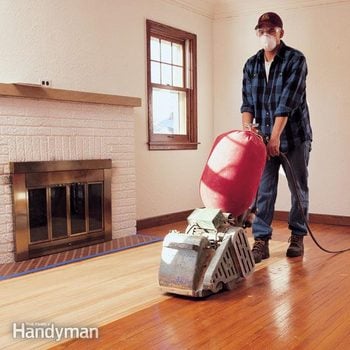






Introducing our floor-sanding expert
Sanding hardwood floors might seem like a pros-only project. It’s a big job that creates big disruptions in your household. And then there’s that big, scary sanding machine…
But it’s really not that difficult. I’ve helped hundreds of homeowners—some of them complete DIY novices—successfully prep their floors for a new finish. Here are some of my most important tips on how to sand hardwood floors.
So says our expert, Kadee Macey, owner of Pete’s Hardwood Floors in St. Paul, Minn. Despite a background in art history and English literature, she’s spent 13 years sanding hardwood and teaching others to do it themselves. And competing in roller derby in her spare time.
Good-bye base shoe
If a room has quarter-round molding (aka “base shoe”) at the bottom of baseboards, I usually pry it off and reinstall it later. Here’s why: Edge sanding slightly lowers the floor and leaves the baseboard standing on a little plateau. You think you won’t notice this, but you will. Edge sanding also scuffs up base shoe, which means touch-up work later.
Removing the base shoe sidesteps both problems. Label the base shoe as you remove it to avoid confusion when you reinstall it. Exception: If the base shoe is bonded to the baseboard by decades of paint buildup, I leave it in place. If you have newer baseboards and no quarter-round, leave it in place, but expect lots of the aforementioned touch-ups.
Pet stains are forever
Water stains usually disappear after a couple of passes of the sander. But stains caused by pet urine often penetrate so deep into the wood that you just can’t sand them out. Bleach formulated for wood floors may be worth a try, but in my experience the results are mediocre at best, and at worst, the wood is left pitted and blotched.
Often, the only solution is to replace the wood—or finish over the stain and think of it as a permanent memorial to a beloved pet.
How do you tell water from pee? Pet stains are darker (deep gray, almost black around the edges) and often look like a map of Indonesia, with big and small islands covering a large area. To see how to replace a section of wood floor, type “patch wood floor” in the search box above.
Prep the room
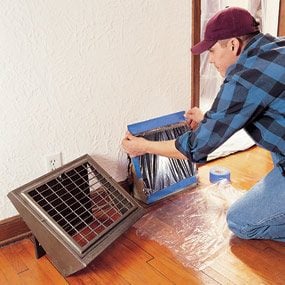
Some of the prep work is obvious, like removing all the furniture and covering doorways with plastic. Here are some steps DIYers often don’t think of:
- Cover or plug air grilles to keep dust out of ducts. Turn off the HVAC system at the thermostat; less air movement means less dust traveling around your house.
- Remove all window coverings and any art on the walls (unless you want to clean them later).
- Remove doors that open into the room. You can’t completely sand under doors, even by opening and closing them.
- Raise low-hanging light fixtures; just tie two links of the chain together with wire. Otherwise, you’re guaranteed to bump your head. Repeatedly.
- Nail down any loose boards with finish nails.
- When you’re sanding, nail heads will rip the sanding belt (which costs you money) or gouge the sanding drum (which costs you more money). So countersink all nails by at least 1/8 in.
- To detect nails drag a metal snow shovel across the floor (upside down). When it hits a nail, you’ll hear it.
Rental tips
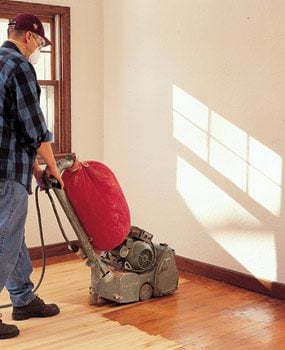
You’ll need two rental machines: a drum sander to sand most of the floor and an edger to sand along baseboards. Here are some tips:
- Rent from a flooring specialty shop rather than a general rental store. You’ll get expertise at no extra expense.
- Measure the room. Knowing the square footage will help the crew at the rental store estimate how many sanding belts and discs you’ll need.
- Prep before you rent. The prep work will take longer than you think. Don’t waste money by picking up the sanders before you’re ready to use them.
- Get a drum sander that uses a continuous belt or sleeve, not one that requires you to wrap a strip of abrasive around the drum. That’s tedious and often leads to chatter marks on the floor.
- Think twice before you rent a flat-pad sander (aka “orbital” or “square-buff” sander). Sure, they’re easier to use, but they’re just not aggressive enough to bite into finishes or hardwoods. “We don’t rent flat-pad sanders. For most jobs they just don’t work.”
- Choose a sander that has a lever to raise and lower the sanding drum. That makes graceful stops and starts easier—and reduces gouging.
Scrape out corners
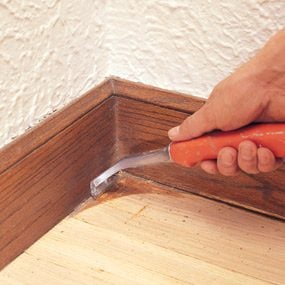
When the sanding is done, use a paint scraper to attack spots that the machines can’t reach. A sharp scraper will leave a super-smooth glazed surface that won’t take finish the same as the surrounding wood. So rough up scraped areas with 80- or 100-grit paper.
Pick a starting grit
It takes coarse abrasive to cut through a finish and into hardwood. But determining just how coarse isn’t easy for a DIYer. So I recommend a trial-and-error process: Start with 36-grit. If that doesn’t completely remove the finish in one pass, step down to 24-grit. If 24-grit doesn’t remove at least three-quarters of the finish in one pass, go to 16-grit. Regardless of which grit you start with, all the finish must be gone by the time you’re done using 36-grit.
Nix the stripper
DIYers often think that paint stripper is a good way to get rid of the finish before sanding. But don’t waste your time. Sanding is faster. And cheaper.
Change belts often
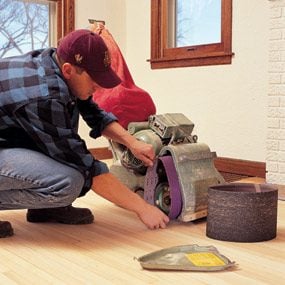
I sell sanding belts, so this might sound self-serving. But trust me. Using dull belts is a strategy you’ll regret. Here’s the problem: After the floor finish is gone, you can’t see whether the sander is doing its job. So you keep sanding. The machine is raising dust and everything seems fine. But the dull paper isn’t cutting deep enough to remove the scratches left by the previous grit. And you may not discover this until you put a finish on the floor. A dull edging disc is even worse, since it won’t remove the ugly cross-grain scratches left by the previous disc.
Even if paper feels sharp, it may be beyond its prime. So the best way to judge is by square footage covered. The belts I sell cover about 250 sq. ft., and edger discs are spent after about 20 sq. ft. That varies, so ask at the rental store.
Edger education
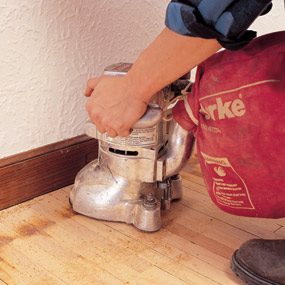
The edger is basically a sanding disc mounted on a big, powerful motor. A simple tool, but not so simple to use. Here are some tips to help you master the edger and minimize the inevitable swirls left by the spinning disc:
- Follow up each phase of drum sanding with edging. After you’ve drum-sanded at 36-grit, for example, edge with 36-grit.
- Place a nylon pad under the sandpaper. This cushion minimizes gouges and deep swirls. Get pads at the rental store.
- Replace the sandpaper when it’s dull. Dull paper won’t remove swirls left by the previous grit.
- At the end of the job, lay a flashlight on the floor to highlight any leftover swirls. Then hand-sand them out with 80- or 100-grit paper.
- A warning to woodworkers: You’ll be tempted to edge with your belt sander, but even the biggest belt sander can’t cut half as fast as an edger. You’ll also be tempted to polish out swirls with a random orbit sander. But beware: That can overpolish the wood so it won’t take finish the same as the surrounding wood. Hand-sanding is safer. “Edging with a belt sander is like digging a ditch with a trowel. You can do it, but it will take forever.”
Don’t skip grits
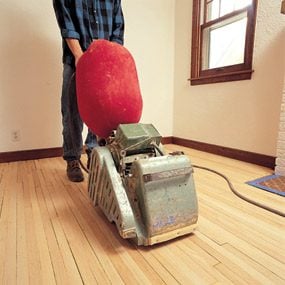
The initial coarse grits remove the finish and flatten the wood. But that’s not enough. You need to progress through every grit to polish off the scratches left by the previous grit. On most of my jobs, the sequence is 24-36-60-80 for coarse-grained wood like oak. Scratches are more visible on fine-grained wood like birch or maple, so I go to 100-grit.
“The most common DIY mistake is timid sanding. If you don’t sand deep enough, you’ll end up with a dingy floor.”
Clean up between grits
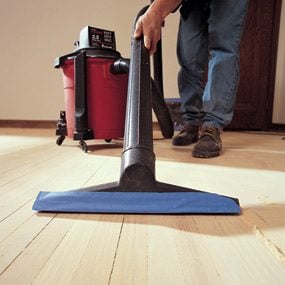
Sweep or vacuum the floor before you move up to the next grit. Even the best abrasives throw off a few granules while sanding. And a 36-grit granule caught under a 60-grit belt will leave an ugly gash in the floor. Wrap the vacuum nozzle with tape to avoid marring the floor.
Screen the floor
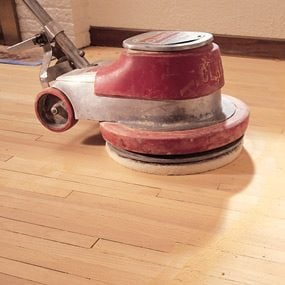
After you’ve finished with the sanders, the floor will look so good that you’ll be tempted to skip this step. But don’t. “Screening” blends the edge-sanded perimeter with the drum-sanded field and polishes away sanding scratches. You can do it with a rented buffing machine or with a sanding pole (like the one used for sanding drywall). Either way, the abrasive to use is 120- or 150-grit sanding screen (again, just like the stuff used on drywall).
Note: For more of Kadee’s wood floor wisdom, go to peteshardwoodfloors.com.
Does DIY make sense?
DIY floor refinishing typically costs about $1 per sq. ft. Hiring a pro costs from $3 to $4 per sq. ft. On average, especially on jobs that are larger than 500 sq. ft., my DIY customers save $1,000 when they learn how to sand hardwood floors by doing it themselves. Not bad for a weekend of work. Keep in mind that pro costs vary a lot, so it’s worth making a few calls to check on pro rates in your area.
Required Tools for this How to Sand Hardwood Floors Project
Have the necessary tools for this how to sand hardwood floors DIY project lined up before you start—you’ll save time and frustration.
- Dust mask
- Hammer
- Nail set
- Paint scraper
- Shop vacuum
- Tape measure
- Wood chisel
Required Materials for this How to Sand Hardwood Floors Project
Avoid last-minute shopping trips by having all your materials ready ahead of time. Here’s a list.
- Masking tape
- Plastic
- Sanding belts and discs
- Sanding screens